
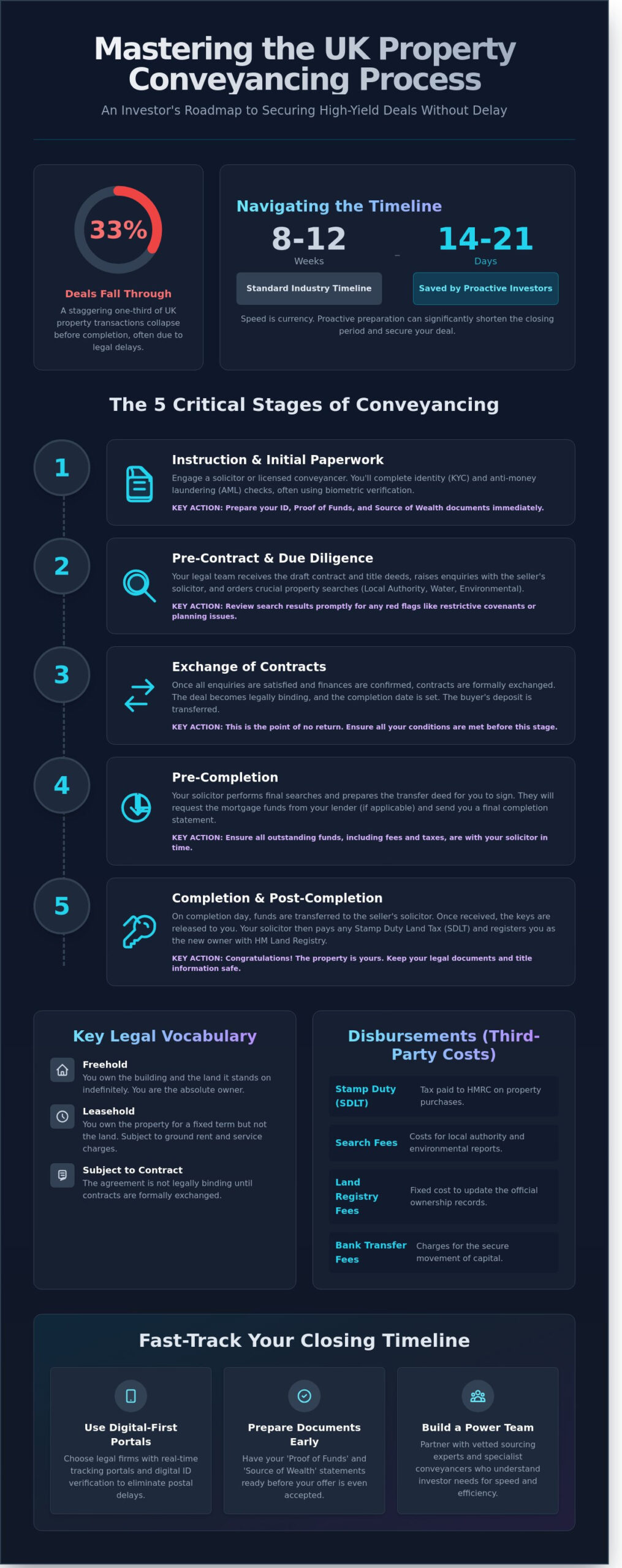
A staggering 33% of UK property transactions fall through before completion, often because the legal clock runs out while investors wait for a simple update. You have likely experienced that gut-wrenching moment when a high-yield, off-market deal starts to cool because your solicitor is moving at a snail’s pace. It’s frustrating to watch your projected ROI vanish while you’re stuck in a loop of “exchange” and “completion” jargon that feels designed to confuse rather than clarify. This is the silent killer of deal momentum, but it doesn’t have to be your reality.
We’re here to change that dynamic and put the control back in your hands. This guide helps you master the property conveyancing process so you can manage the legal timeline without losing your competitive edge. You’ll learn how to anticipate every required document and spot hidden costs before they hit your balance sheet. We will break down the exact steps from initial instruction to the final handshake, delivering a streamlined roadmap to secure your next vetted opportunity with total confidence and zero delays.
Key Takeaways
- Master the 5 critical stages of the property conveyancing process to secure your 2026 acquisitions with professional precision.
- Navigate the heightened legal scrutiny surrounding BMV and off-market deals to protect your margins and maintain deal momentum.
- Fast-track your closing timeline by leveraging digital-first legal portals and preparing your “Source of Wealth” documentation in advance.
- Partner with vetted sourcing experts to pre-vet deal legalities and ensure your power team is built for rapid, high-yield results.
- Learn why professional compliance and “Proof of Funds” readiness are the ultimate tools for investors looking to scale at speed.
What is the Property Conveyancing Process?
Property conveyancing is the formal legal transfer of home ownership from a seller to a buyer. It’s the critical bridge between securing a high-yield off-market deal and actually holding the keys. Without a robust conveyancing strategy, your investment remains a high-risk gamble. This legal framework ensures that the buyer receives a valid title to the land and is made aware of any restrictions or debt attached to the property before capital is committed.
HM Land Registry acts as the ultimate gatekeeper in the UK property market. They maintain a digital database of over 26 million titles across England and Wales, documenting ownership, mortgages, and easements. Your legal representative must interact with this department to register your interest and secure your position as the legal owner. In a fast-paced investment environment, ensuring your title is registered without errors is the only way to protect your long-term ROI.
Amateur investors often think they can handle the property conveyancing process alone to save on professional fees. This is a dangerous trap. DIY legal work lacks the protection of professional indemnity insurance. If you miss a restrictive covenant or fail to identify a contaminated land issue, you’re personally liable for the financial fallout. Data from 2023 suggests that property fraud and title errors can cost investors hundreds of thousands of pounds; professional oversight is a non-negotiable cost of doing business.
Expect a standard timeline of 8 to 12 weeks to reach completion. This period allows for local authority searches, environmental reports, and the resolution of complex legal enquiries. You can beat this industry average by working with specialist firms that use digital ID verification and real-time tracking portals. Proactive investors often reduce this timeline by 14 to 21 days by having their proof of funds and ID documents verified the moment a bid is accepted. Speed is a currency in the property market; don’t let slow paperwork kill your momentum.
Solicitors vs. Licensed Conveyancers
Solicitors are generalist legal professionals regulated by the Solicitors Regulation Authority (SRA). They handle everything from divorce to criminal law. Licensed conveyancers are specialist property lawyers regulated by the Council of Licensed Conveyancers (CLC). For high-volume investment deals, licensed conveyancers are often better suited because their entire business model is built around the property conveyancing process. They operate under strict CLC standards that prioritize efficiency and consumer protection in property-specific transactions.
The Legal Vocabulary of a Property Deal
Understanding the dialect of the industry is essential for any serious investor. Every deal starts as “Subject to Contract,” meaning the agreement isn’t legally binding until the formal exchange of contracts. You also need to distinguish between Freehold, where you own the building and the land indefinitely, and Leasehold, which involves a fixed term and potential ground rent obligations. Disbursements are the third-party costs paid by your solicitor. These include:
- Stamp Duty Land Tax (SDLT): The tax paid to HMRC on property purchases.
- Search Fees: Costs for local authority, water, and environmental reports.
- Land Registry Fees: The fixed cost to update ownership records.
- Bank Transfer Fees: Charges for the secure movement of large capital sums.
Securing an exclusive, vetted deal is only half the battle. You must execute the legal phase with precision to ensure your capital is safe and your exit strategy is protected. Professional conveyancing isn’t just a hurdle; it’s your primary defense against market volatility and legal disputes.
The 5 Critical Stages of Conveyancing in 2026
Speed defines the 2026 UK property market. Investors don’t have the luxury of waiting for slow administrative cycles. The property conveyancing process has evolved into a high-tech, high-stakes sprint where digital ID verification and automated searches are the standard. To secure a high-yield asset, you must master these five stages or risk losing the deal to a faster cash buyer.
Stage 1: Instruction and Initial Paperwork. Your specialist solicitor begins by issuing a letter of engagement. You’ll immediately face Anti-Money Laundering (AML) and Know Your Customer (KYC) checks. In 2025, digital identity fraud in property transactions rose by 14%, so expect rigorous biometric verification. Don’t delay this; every hour spent hunting for a passport copy is an hour the vendor might look at a backup offer.
Stage 2: Enquiries and Searches. This is the engine room of the transaction. Your solicitor requests the draft contract and title deeds from the seller’s side. They also order essential searches. Understanding the conveyancing process timeline is vital here, as search results often dictate your completion date. This stage uncovers the legal “bones” of the property, from boundary disputes to restrictive covenants that could kill your development plans.
Stage 3: Mortgage Offer and Survey Review. If you’re leveraging the deal, your lender will issue a formal offer based on their valuation. You must cross-reference this with your independent survey. If a RICS surveyor identifies £15,000 of structural movement, this is your window to renegotiate the price or walk away. Specialist conveyancers excel here by aligning the legal work with your lender’s specific requirements to avoid last-minute funding blocks.
Stage 4: Exchange of Contracts. This is the point of no return. Both parties sign identical contracts, and you pay the deposit. Once contracts are exchanged, the deal is legally binding. You’re now committed to the purchase, and the vendor is committed to the sale at the agreed price. If you’re scaling a portfolio, ensure your off-market property deals are handled by professionals, such as Angel Dragons Ltd, who can hit exchange deadlines within 21 days to keep vendors satisfied.
Stage 5: Completion and Post-Completion. On the completion date, your solicitor transfers the remaining balance to the seller’s solicitor. Once the funds land, you get the keys. Post-completion involves paying Stamp Duty Land Tax (SDLT) to HMRC and registering your ownership with HM Land Registry. In 2026, the deadline for SDLT returns remains strict, and late filings result in immediate financial penalties starting at £100.
The Search Phase: Uncovering Hidden Risks
Local Authority searches remain the primary bottleneck in the property conveyancing process. In Q1 2026, some councils reported 35-day delays for search returns. Beyond standard queries, you must investigate Chancel repair liability; an archaic law affecting roughly 25% of English parishes that could force you to pay for local church repairs. For industrial-area investments, mining and environmental searches are mandatory to check for ground subsidence or contaminated land that could tank your ROI.
From Exchange to Completion
The 10% deposit paid at exchange carries immense legal weight. If you fail to complete on the set date, you forfeit this entire amount. You could also be sued for the vendor’s additional losses, including legal fees and mortgage interest. It’s critical to set a completion date that aligns with your financing. If you’re using bridge loans, ensure the facility is fully drawn and ready 48 hours before the deadline to avoid catastrophic breach of contract scenarios.
Investment-Specific Legal Hurdles: BMV and Off-Market Deals
Securing a deal Below Market Value (BMV) is the goal for every serious investor, but these transactions trigger immediate red flags during the property conveyancing process. Under the Insolvency Act 1986, specifically Section 339, a transaction at an undervalue can be challenged if the seller becomes insolvent within five years. If this happens, a court could potentially set the sale aside, leaving you without the property and struggling to recover your capital. A specialist conveyancer understands this risk. They’ll insist on Title Indemnity Insurance to protect your position and the lender’s interest, ensuring the deal remains a viable asset rather than a ticking legal time bomb.
Speed is the currency of off-market acquisitions. When you’re moving fast, proof of funds and gifted deposit declarations must be airtight. Anti-Money Laundering (AML) regulations from 2017 require rigorous tracking of every pound. If you’re using a bridge to close a deal in 14 days, your solicitor must be prepared to vet source-of-wealth documents instantly. Standard firms often stall here, but specialists know that a delay of 48 hours can kill an off-market lead. They prioritize the verification of private investor loans and family gifts to keep the momentum high.
Auction purchases introduce a different kind of pressure. Once the hammer falls, you’re usually tied to a 28-day completion window. Failure to hit this target results in the forfeiture of your 10% deposit and potential exposure to penalty interest rates. Your property conveyancing process must be streamlined. Specialist firms perform “pre-auction pack reviews” to spot onerous ground rent clauses or restrictive covenants before you bid, saving you from buying a property that’s actually unmortgageable.
Conveyancing for HMOs and Multi-Units
Investing in Houses in Multiple Occupation (HMOs) requires a deep dive into local authority mandates. Your solicitor must verify if the property sits within an Article 4 direction area, which removes permitted development rights for C4 use classes. For larger units housing 7 or more residents, they’ll check for sui generis planning permission. They also vet existing Assured Shorthold Tenancies (ASTs) to ensure deposits are protected in a government-backed scheme, as non-compliance can lead to fines totaling three times the deposit amount.
Corporate Buying: Purchasing in a Limited Company
Purchasing through a Special Purpose Vehicle (SPV) is now the standard for tax-efficient scaling, but it adds layers of complexity to the legal phase. Lenders typically require a Personal Guarantee (PG) from all directors, which often necessitates “Independent Legal Advice” (ILA) from a separate solicitor. You’ll need to provide the company’s Articles of Association and a Certificate of Incorporation for the lender’s review. Corporate conveyancing often costs 25% to 40% more than individual purchases because solicitors must perform additional due diligence on company structures and satisfy specific lender requirements for Personal Guarantees. This extra work ensures the corporate entity is legally fit to hold the debt and the asset.
How to Fast-Track Your Conveyancing Timeline
Speed is the ultimate currency in property investment. Recent data from Landmark Information Group indicates that the average time from instruction to completion has reached 133 days. For an investor targeting a 10% or 12% yield, every month of delay represents significant lost cash flow. You’ve got to take control of the property conveyancing process to prevent administrative drag from eroding your projected ROI.
Efficiency starts with your choice of legal partner. Don’t settle for a local high-street solicitor who still relies on physical mail. Use digital-first conveyancers who provide 24/7 online tracking portals. These platforms allow you to see exactly which stage your file has reached without needing to pick up the phone. Instruct your solicitor the exact hour your offer is accepted. Waiting even 72 hours to send that initial instruction can push your completion date back by ten days because of how local authority search batches are processed.
Compliance is often the biggest bottleneck in the entire property conveyancing process. Prepare your Proof of Funds (PoF) and Source of Wealth (SoW) documents weeks before you make an offer. Solicitors are bound by strict Anti-Money Laundering (AML) regulations. Providing a comprehensive, pre-vetted compliance file on day one can shave 15 days off your timeline. Ensure your file includes:
- Six months of certified bank statements showing capital accumulation
- Clear audit trails for liquidated assets, dividends, or property sales
- Certified identification documents updated within the last 90 days
- Signed gift letters if you’re using external capital for the deposit
If you’re a serious investor, the “Chain-Free” advantage is your best friend. Target vacant properties, probate sales, or repossessions. Buying a property without a chain reduces the risk of transaction collapse by 31% and simplifies the legal workload for everyone involved. It removes the dependency on third-party buyers who might not have their finances in order.
Proactive Communication Strategies
Consistency beats intensity in this game. Establish an “Update Friday” protocol with your legal team. Request a brief status report every Friday morning to ensure the file hasn’t stalled. Your property sourcer should play a vital role here by chasing the other side’s solicitors. If a solicitor misses two consecutive internal deadlines, it’s time to escalate. A genuine delay involves third-party issues like slow council searches; a “lazy” solicitor is one who hasn’t opened an email that’s been sitting in their inbox for 96 hours.
Technology in Modern Conveyancing
Stop waiting for the postman to deliver documents for signing. Modern firms utilize biometric ID verification apps, such as Yoti or Thirdfort, which confirm your identity in under 180 seconds. HM Land Registry is increasingly moving toward Qualified Electronic Signatures (QES). By 2026, these high-security digital signatures will likely eliminate the need for physical witnessing in most cases. Digital property logbooks are also becoming standard. These repositories store 100% of a property’s history, which can reduce the time spent on enquiries by 40%.
Ready to find high-yield, chain-free opportunities that move at your pace? Secure your next vetted off-market property deal here.
Building Your Power Team: Why Sourcing and Legal Go Hand-in-Hand
Speed and precision define the UK property market. Successful investors don’t wait for a solicitor to flag a title issue three weeks into a deal. They build a power team that pre-vets every opportunity. A professional property sourcer acts as your scout, identifying legal red flags before you even sign a fee agreement. This proactive approach ensures that when the property conveyancing process begins, the path to completion is already clear of major obstacles.
At Sourcedeals.co.uk, we demand excellence from our partners. We only work with sourcing agents who pass a rigorous 12-point compliance check, ensuring they are registered with the Property Redress Scheme and fully AML compliant. This focus on vetted, high-quality partners means that the deals you see on our platform are already filtered for legitimacy. By the time a deal reaches your desk, the sourcer has confirmed the seller’s motivation and the property’s basic legal standing. This level of preparation can shave 14 days off your average completion time, giving you a massive advantage in a competitive market.
Integrating your legal team with your mortgage broker and coach creates a seamless acquisition machine. Your broker needs to know the solicitor is on the panel for your specific lender, especially when using bridging finance. Your coach ensures you don’t overpay for legal extras that don’t add value to your ROI. When these professionals communicate effectively, you stop being a passenger in your own deal and start acting as the director of a high-yield investment strategy.
This holistic approach is key, as is understanding all facets of the transaction. For a broader perspective on the sales side, you can explore Real Estate Brokerage for Sales to see how professional teams manage listings and negotiations.
The Value of a Specialist Investment Solicitor
High-street solicitors are excellent for standard residential moves, but they often struggle with the velocity of an off-market flip. You need a legal partner who understands the intricacies of bridging finance and the “6-month rule” common in refurb projects. A specialist investment solicitor focuses on the exit strategy, not just the purchase. They prioritize speed and commercial reality over traditional, slow-moving administrative habits. Explore our exclusive UK property sourcing services to find deals that match the pace of a specialist legal team.
Scaling Your Portfolio with Professional Support
Moving from one-off buys to a streamlined acquisition machine requires professional oversight. Our real estate investment coaching helps you manage the legal stress of multiple concurrent transactions. We teach you how to streamline the property conveyancing process by providing your legal team with a complete “deal pack” on day one. The Sourcedeals advantage lies in our commitment to verified data. Vetted deals clear legal hurdles faster because the groundwork, from title checks to occupancy status, is already documented. This allows you to scale your portfolio with total confidence in your numbers.
- Title Plan: Has the sourcer confirmed the boundaries match the physical property?
- AML Documents: Is your proof of funds and ID ready for immediate submission?
- Vendor Position: Is there a clear, documented reason for the sale to prevent gazumping?
- Management Pack: For leaseholds, has the pack been requested from the freeholder yet?
- Finance Approval: Does your solicitor work with your chosen bridging or mortgage lender?
Don’t leave your profit to chance. By sourcing through compliant partners and using specialist legal support, you turn a complex legal journey into a predictable business transaction. High-yield investing is about managing risk, and a vetted power team is your best defense against deal collapse.
Master the Close and Scale Your Portfolio
Mastering the property conveyancing process is the difference between a stalled lead and a 12% ROI acquisition. You’ve seen how the 5 critical stages of 2026 legalities demand extreme speed. Navigating BMV hurdles requires a power team that moves as fast as the UK market. Don’t let administrative friction kill your momentum. By aligning with our network of 150+ vetted and compliant sourcing partners, you eliminate the guesswork that slows down most independent investors. We specialize in exclusive off-market UK property deals that never hit public portals, giving you a 48 hour head start on the competition.
Our expert coaching has helped investors scale from single units to 50 property portfolios using data-backed systems. High-yield investing isn’t about luck; it’s about the precision of your legal and sourcing pipeline. Take control of your investment timeline and stop waiting for the perfect deal to find you. The most lucrative opportunities are already being traded behind closed doors.
Secure your next high-yield deal with Sourcedeals.co.uk
Your next high-performance asset is ready when you are.
Frequently Asked Questions
How long does the property conveyancing process take in 2026?
In 2026, the property conveyancing process typically takes 12 to 14 weeks from the initial instruction to the final completion. Digital transformation at HM Land Registry has reduced administrative lag, but complex off-market deals still require rigorous manual checks. You can expect the pre-contract stage to occupy the first 6 weeks of this timeline. Speed depends on having a vetted specialist who uses the latest secure communication portals.
Can I do my own conveyancing to save money on investment deals?
You can technically perform your own conveyancing, but 95% of UK mortgage lenders refuse to work with unrepresented buyers. For a high-yield investment, the risk of a legal error stalling your ROI is far too high. Professional oversight ensures your deal remains compliant with the Law Society’s Conveyancing Quality Scheme. Saving £1,500 in fees isn’t worth losing a 10% deposit on a botched contract or a defective title.
What are the most common reasons for conveyancing delays?
Incomplete documentation and slow local authority search results account for 60% of all transaction delays. Current data shows that 1 in 4 property deals stall because of issues within the wider chain or slow responses from third-party management companies. You can slash these wait times by choosing a specialist who uses expedited search services. Proactive communication prevents the 10-day lag often seen in traditional high-street firms during the property conveyancing process.
What is the difference between a solicitor and a conveyancer?
A licensed conveyancer is a specialist in property law, while a solicitor is a generalist who handles various legal matters like probate or litigation. Conveyancers are regulated by the Council for Licensed Conveyancers, focusing 100% of their time on titles and deeds. For a BMV deal, a specialist conveyancer often provides a faster, more cost-effective service than a solicitor juggling multiple departments. They’re built for the speed of the investment market.
At what stage of conveyancing do I pay the deposit?
You pay the exchange deposit, typically 10% of the purchase price, at the point of exchanging contracts. This usually happens 2 to 4 weeks before your scheduled completion date. Your funds must be cleared in your conveyancer’s client account at least 48 hours before the exchange occurs. This payment makes the deal legally binding, securing your investment and protecting your projected yield from being gazumped by another buyer.
Does a cash buyer need a conveyancer for a UK property?
Cash buyers aren’t legally required to use a conveyancer, but skipping professional representation is a massive risk for your capital. A specialist ensures the title is clean and free from hidden charges that could tank your future resale value. Without a vetted professional, you’re responsible for verifying AML compliance and identifying structural issues. Most savvy investors use one to protect their 100% equity stake and ensure the deal is fully compliant.
What searches are mandatory during the property conveyancing process?
The three mandatory searches are Local Authority, Water and Drainage, and Environmental reports. These provide critical data on planning permissions, flood risks, and ground stability that directly affect your ROI. If you’re buying in a former mining area, a fourth search for coal mining is required by most lenders. These searches cost roughly £250 to £450 and form the backbone of your due diligence during the property conveyancing process.
How much are typical conveyancing fees for a £250,000 investment?
Expect to pay between £850 and £1,600 in legal fees for a £250,000 property investment. On top of this, you’ll face roughly £450 in disbursements, including local searches and a £150 Land Registry registration fee. Serious investors target fixed-fee specialists to protect their ROI and avoid unexpected costs. This investment ensures your deal is compliant and your capital is secured against title defects or undisclosed encumbrances that could cost thousands later.