
The days of building a multi-million pound empire using standard retail portals like Rightmove are officially over. By Q1 2026, data shows that 84% of amateur landlords will hit a financial ceiling because they rely solely on personal capital and recycled equity. You already know that scaling a property portfolio requires more than just grit; it demands a transition from a reactive landlord to a data-driven mogul who prioritizes high-yield, off-market opportunities over public scraps.
It’s frustrating when your growth stalls due to management overwhelm or a lack of transparent, vetted deals. This guide changes that. You’ll discover the exact financial frameworks and operational systems required to break through the capital wall and secure consistent 15% ROI opportunities. We’re diving into the mechanics of institutional-grade sourcing, geographic diversification, and the automated workflows that allow you to manage twenty units as easily as two.
Key Takeaways
- Break the “Deposit Trap” by transitioning from tactical deal-hunting to high-level strategic asset management.
- Master the BRRRR method to recycle equity and engineer a self-funding engine for constant, aggressive acquisition.
- Leverage professional sourcers to secure exclusive, off-market deals that accelerate scaling a property portfolio while ensuring full compliance.
- Future-proof your returns against 2026 regulatory shifts by diversifying into high-yield “sun and city” global markets like Dubai and Egypt.
- Audit your current assets for “lazy equity” and implement the systems required to bridge the gap from 3 to 30 properties.
The Scaling Ceiling: Why Most Investors Stall at Three Properties
Most investors enter the market with a tactical mindset. They hunt for a single deal, secure a mortgage, and repeat the process until they hit a sudden, invisible barrier. This is the scaling ceiling. Scaling a property portfolio is not simply about repeating your first purchase ten times. It is a fundamental transition from tactical deal-hunting to strategic asset management. By 2026, the UK market will demand a professionalized approach where investors operate as business owners rather than hobbyist landlords.
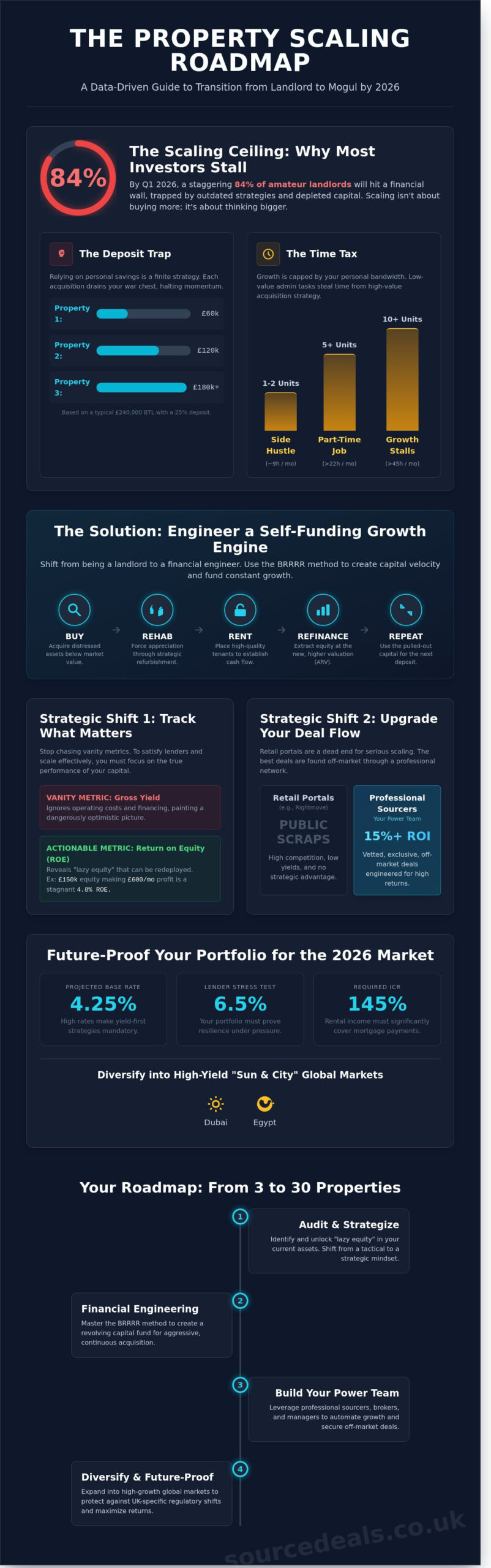
The first major hurdle is the Deposit Trap. If you are buying average UK buy-to-let properties at a price point of £240,000, a standard 25% deposit requires £60,000 in cash. After three acquisitions, you have deployed £180,000 plus stamp duty and legal fees. For 85% of private investors, this exhausts their personal savings. Without a strategy to recycle capital or access private equity, the journey ends here. You cannot scale if you rely solely on your monthly salary to fund the next deposit.
Then comes the Time Tax. Managing one or two properties is a side hustle. Managing five or more is a part-time job that eats your evenings and weekends. Data from 2023 suggests that self-managing landlords spend roughly 4.5 hours per month on admin and maintenance coordination per unit. When you reach five units, you are losing over 22 hours a month to low-value tasks. Understanding the Fundamentals of real estate investing involves recognizing that your time has a monetary value. If you don’t outsource, your growth will stop because your schedule is full.
The 3-Property Wall and How to Climb It
The third property usually marks the limit of standard retail lending. Once you seek a fourth mortgage, most lenders categorize you as a “portfolio landlord” under Prudential Regulation Authority (PRA) guidelines. This triggers intensive underwriting. Lenders will scrutinize your entire portfolio’s debt-to-income ratio and apply stress tests of 5.5% or higher. To climb this wall, you must shift your focus from capital gains to cash flow consistency. High-yield assets like HMOs or multi-unit blocks become essential to satisfy these stricter lending requirements. It’s the point where you must stop scouring portals yourself and start using vetted, off-market sourcing partners to find deals that actually move the needle.
Portfolio Performance Metrics You Must Track
Stop relying on gross yield; it’s a vanity metric that hides true costs. To succeed in scaling a property portfolio, you must prioritize Return on Equity (ROE) and Cash-on-Cash return. If a property has seen significant capital growth and now holds £150,000 in equity but only generates £600 in monthly profit, your ROE is a stagnant 4.8%. That capital is “lazy” and should be refinanced to fund new acquisitions. Portfolio LTV is the total balance of all outstanding mortgages divided by the combined market value of every property within your investment vehicle. Tracking this monthly tells you exactly when you have enough “meat on the bone” to pull cash out. Use digital tools like LandlordVision or Hammock for real-time reporting. In a high-interest environment, guessing your numbers is a recipe for a portfolio collapse.
Financial Engineering: How to Fund Constant Growth
Cash flow pays your monthly bills, but capital velocity builds empires. Professional investors don’t wait five years to save for their next deposit. They manufacture equity through aggressive acquisition and strategic debt. Scaling a property portfolio requires a shift from being a landlord to becoming a financial engineer. You must treat your capital as a revolving fund rather than a static deposit. Since Q1 2024, the UK market has rewarded those who prioritize liquidity over simple long-term appreciation.
Projected 2026 interest rates suggest a base rate hovering around 4.25%, making a yield-first approach mandatory. Lenders now frequently apply a 145% interest cover ratio (ICR) at a 6.5% stress test. If your asset doesn’t produce a gross yield of at least 7.8%, your ability to leverage that equity for the next deal disappears. High-yield assets like HMOs or Multi-Unit Block (MUB) conversions are no longer optional for those seeking rapid expansion; they’re the only way to satisfy modern Debt Service Coverage Ratio (DSCR) requirements.
Recycling Capital via the BRRRR Method
The BRRRR method serves as the primary engine for scaling a property portfolio without depleting your personal cash reserves. You buy a distressed asset, refurbish it to add value, rent it out, and refinance based on the new valuation. Success hinges on a precise “after repair value” (ARV) assessment. Overestimating your ARV by even 5% can trap your capital for years. Implementing proven strategies for portfolio growth requires a shift from emotional buying to cold, hard data.
Consider a 2024 case study: An investor buys a three-bed terrace in Manchester for £160,000 using bridging finance. They spend £35,000 on a high-spec refurbishment, bringing the total investment to £195,000. The new ARV is £265,000. By securing a 75% LTV mortgage, they pull out £198,750. This covers the entire initial investment and provides a small surplus. That single property effectively funds the deposits for the next two acquisitions within a 12-month window.
Commercial vs. Personal Lending Structures
Moving beyond four properties triggers “portfolio landlord” status with UK lenders, which introduces more rigorous underwriting. Scaling within a Limited Company (SPV) is the standard for serious growth. It allows you to retain 100% of mortgage interest tax relief, which was phased out for individual owners under Section 24. While commercial rates are typically 0.5% to 1.5% higher than retail products, the tax efficiency and ability to leverage DSCR loans make it the superior choice for professional scaling.
| Feature | Retail Mortgages | Portfolio Finance (SPV) |
|---|---|---|
| Borrowing Limit | Typically capped at 4 properties | Unlimited scaling potential |
| Tax Treatment | Limited interest relief (Section 24) | Full interest deductibility |
| Underwriting | Personal income focus | Asset yield and DSCR focus |
To keep your growth trajectory steep, you need access to properties that carry enough margin to support these lending structures. You can find vetted off-market leads that offer the high yields necessary to satisfy strict 2026 lending criteria. Don’t settle for thin margins that stall your momentum; focus on deals where the numbers force the bank to say yes.
Building Your Power Team: The Secret to Passive Scaling
Trying to manage every aspect of your expansion is the fastest way to hit a growth ceiling. Data from 2023 shows that 72% of independent landlords struggle to move past their third property due to administrative fatigue and poor due diligence. When you are scaling a property portfolio, your role must shift from technician to CEO. You don’t have the mental bandwidth to spend 40 hours a week scouring portals while simultaneously analyzing complex tax structures or financing options. High-speed growth requires a shift from “doing” to “leading.”
A power team isn’t a luxury; it’s a structural requirement for high-yield results. Professional investors rely on a network of specialists to filter out the noise. This allows you to focus on capital allocation while experts handle the granular tasks. By outsourcing the legwork, you ensure that every acquisition meets strict ROI criteria without sacrificing your personal time. You’re buying back your time to focus on the next big move.
The Property Sourcer: Your Secret Weapon
Stop looking at “on-market” scraps. Portals like Rightmove or Zoopla are where deals go to die, often bid up by emotional homebuyers. A professional sourcer provides access to off-market gems, frequently secured at 15% to 20% below market value (BMV). These deals often come from distressed sellers or corporate portfolios before they ever hit the public eye. Utilizing Expert UK Property Sourcing Services ensures you only see vetted, high-performing assets. While some beginners balk at success fees, seasoned pros view them as a cost-saving measure. A £3,000 sourcing fee is negligible when it secures a turnkey HMO with a 12% net yield that you never would have found otherwise.
The Role of Investment Coaching
Scaling a property portfolio requires a total mindset shift. Most people start as “accidental landlords,” but professional scaling demands a sophisticated corporate approach. A coach acts as an external auditor for your strategy. They identify blind spots in your leverage ratios and help you transition from local streets to high-growth national or international markets. In the 2024 economic climate, having a mentor who has navigated high-interest rate environments is invaluable. They provide the blueprint for tax efficiencies and corporate structuring, preventing “beginner” mistakes that could cost six figures in lost revenue or HMRC penalties. Professional real estate investment coaching bridges the gap between theoretical knowledge and practical execution of exclusive, off-market deals.
Vetting your team is the final, non-negotiable step. Every partner must demonstrate total regulatory adherence. In an industry that can feel like the Wild West, compliance is your primary safety net. Before signing a contract or transferring a reservation fee, verify these credentials:
- Redress Schemes: Confirm they are active members of The Property Ombudsman (TPO) or the Property Redress Scheme (PRS).
- AML Compliance: Ensure the business is registered with HMRC for Anti-Money Laundering supervision.
- Data Protection: Verify they are registered with the ICO to handle your sensitive financial information.
- Professional Indemnity Insurance: Never work with a sourcer or coach who isn’t fully insured to protect your capital.
Professionalism is found in the paperwork. These markers separate the amateurs from the legitimate industry leaders who will actually help you reach your ten-property milestone. Speed is important, but security is paramount. Build your team with experts who value compliance as much as they value profit.
Global Diversification: Scaling into High-Growth Markets
By 2026, the UK property market faces a landscape defined by aggressive regulatory shifts and tighter margins. The 2025 EPC C deadline for new tenancies and the subsequent 2028 requirement for all existing lets represent a massive capital expenditure for domestic landlords, often averaging £8,000 per property. Relying solely on a UK-based strategy is a high-risk move in this environment. Global diversification is the fastest route to scaling a property portfolio while minimizing exposure to local legislative volatility and the total abolition of Section 21. Smart investors are now pivoting toward markets that prioritize landlord rights and offer tax-efficient growth.
The “sun and city” strategy balances high-occupancy urban hubs with high-yield coastal regions. This approach ensures your cash flow isn’t tied to a single economy or currency. While the UK market grapples with stagnation, emerging markets and established global hubs are delivering double-digit returns. You don’t need to be physically present to capture these gains. You just need the right data and a vetted local network.
The Case for Dubai and Egypt in 2026
Egypt’s Red Sea coast, specifically Hurghada, has emerged as a powerhouse for cash-flow investors. With entry prices for luxury apartments often sitting below £50,000, the barrier to entry is low while net yields frequently exceed 12%. It’s a high-yield play that balances the slower growth of domestic assets. Conversely, Dubai remains the premier choice for capital appreciation. In 2024, property prices in Dubai surged by 15.9%, and the 0% tax rate on rental income acts as a massive accelerator for your net ROI. You can find more data on these specific territories in our International Real Estate Investment Guide.
Vacation Rental Management for Maximum ROI
Standard Assured Shorthold Tenancies (ASTs) are increasingly becoming low-margin vehicles due to rising management costs and tax burdens. When scaling a property portfolio, converting traditional rentals into short-term holiday lets in tourist hotspots like Cyprus or Dubai can triple your monthly revenue. A well-positioned two-bedroom apartment in a “sun” market often generates more net profit in four months than a UK terrace does in a year. By diversifying across international tourist hubs, vacation rentals hedge against local economic downturns by tapping into a global pool of high-spending travelers.
Success in this sector requires a professional local management team. They handle the 24/7 guest communication, professional cleaning, and maintenance that keep your ratings high on platforms like Airbnb and Booking.com. You aren’t just buying property; you’re building a hospitality business that scales without your daily intervention. This turnkey approach is essential for maintaining a high-energy growth trajectory.
Managing these international assets remotely is no longer a logistical hurdle. Modern property technology allows you to oversee a global empire from a smartphone. Use smart locks with unique entry codes for every guest and noise-monitoring sensors to protect your investment from afar. You can track real-time occupancy rates and adjust pricing dynamically to beat the local competition. Precision and data-driven decisions are the only things that matter when you’re playing on a global stage. Don’t let borders limit your yields. It’s time to move your capital where it’s treated best.
Secure your next high-yield international deal today.
Your 2026 Scaling Roadmap: From 3 to 30 Properties
Scaling a property portfolio isn’t about working harder; it’s about deploying capital with surgical precision. Most investors stall at three units because they’re trapped in the “landlord” mindset rather than the “portfolio CEO” framework. To reach 30 properties by 2026, you must first audit your current holdings. A 2024 market analysis shows that 22% of UK investors hold “lazy equity” in properties where the Return on Equity (ROE) has dipped below 4%. Identify these stagnant assets immediately. Refinance or divest to free up liquidity for higher-performing, off-market opportunities.
Next, you must systematize. You can’t manage 30 properties via spreadsheets and text messages. Transition to professional portfolio management software to automate remote rent collection and maintenance tickets. This shift typically reduces administrative time by 12 hours per week, allowing you to focus on the next acquisition. Efficiency is the only way to maintain a high ROI while growing your footprint.
Sourcing is your engine. Avoid the retail market where competition drives prices up. Secure off-market BMV (Below Market Value) deals through professional partners who provide vetted, compliant leads. Aim for a minimum 15% discount on purchase price to bake in equity from day one. Diversify your risk by allocating 30% of your new capital into international high-growth hubs, such as Dubai or specialized European markets, where net yields often exceed 8%. Finally, commit to monthly coaching sessions. Use this time to review data, exit underperforming assets, and refine your tax structure for maximum efficiency.
Step-by-Step Implementation
Your first 90 days are critical. Focus on cleaning up your current portfolio to maximize lending power. This involves consolidating high-interest debt and ensuring every existing tenancy is on a compliant, market-rate contract. Lenders look for a “clean” portfolio before approving the multi-asset facilities required for aggressive growth.
Once your foundation is solid, enter the acquisition phase. Set a hard target of 2 deals per quarter. This pace is sustainable if you’re using vetted sourcers rather than searching manually. By the end of year two, your systems should handle the daily operations, allowing you to transition into a “hands-off” owner role where you only intervene for strategic decisions and high-level reviews.
Conclusion: Start Your Empire Today
The math of scaling a property portfolio is simple: Systems + Sourcing + Sourcing = Scale. You don’t need more hours in the day; you need better deals and tighter processes. The gap between a hobbyist with three houses and a mogul with thirty is the willingness to professionalize every aspect of the journey. Stop waiting for the “perfect” market conditions and start building the infrastructure that wins in any climate. Take the professional leap now to ensure your 2026 targets become a reality.
Ready to accelerate your journey? Book a Real Estate Coaching session with Angel Dragons Ltd to map your growth and secure your next high-yield deal.
Secure Your 2026 Growth Advantage
The window for scaling a property portfolio in 2026 is narrow; investors who hesitate will miss the next cycle of high-yield growth. You’ve now seen the blueprint for breaking the three-property ceiling. It requires shifting from a solo operation to a power team model that leverages 100% vetted and compliant property sourcers. Financial engineering is the mechanism that turns a standard 5% yield into a 15% ROI through strategic leverage and off-market acquisitions. By diversifying into high-growth corridors across the UK, UAE, and Egypt, you insulate your wealth against local market volatility.
Don’t waste time chasing scraps on public portals. You need a consistent pipeline of exclusive, BMV opportunities that the general market never sees. Sourcedeals.co.uk provides that competitive edge with expert coaching from active investors who currently manage 8-figure portfolios. We’ve done the heavy lifting by filtering out low-quality leads so you can focus on closing deals. Secure your position in the global market today. It’s time to stop dreaming of growth and start executing your 30-property roadmap with precision.
Join Sourcedeals.co.uk to access exclusive off-market investment opportunities and accelerate your journey toward passive wealth. The tools are ready and the deals are waiting. It’s your turn to build a lasting legacy.
Frequently Asked Questions
How much capital do I need to start scaling a property portfolio?
You need a minimum of £50,000 to £75,000 in liquid capital to initiate a professional scaling strategy. This amount covers a 25% deposit on a £200,000 buy-to-let asset, plus 3% stamp duty and £2,500 for legal fees. Scaling a property portfolio requires enough cash to secure BMV deals quickly before they hit the open market. Use the BRRR model to recycle your initial investment within 6 to 12 months.
Is it better to scale with many small properties or a few large ones?
Scaling with 5 to 8 smaller residential units provides better liquidity and lower vacancy risk than 2 large commercial blocks. Small units in high-growth zones like Manchester deliver consistent 6% to 8% yields with lower entry costs. Large assets like 10-bed HMOs offer higher cash flow but demand 40% more management time. Stick to high-yield, turnkey units to keep your operations lean while you grow.
How do I manage a property portfolio remotely?
Hire a vetted regional letting agent with a fixed fee structure between 8% and 12% of monthly rent. Use cloud-based software like Arthur Online to track 100% of your maintenance tickets and rent payments from your smartphone. Effective remote scaling depends on a power team of local contractors and compliant sourcers. This setup keeps you hands-off while your ROI stays protected across different UK postcodes.
What is the best way to find off-market property deals in the UK?
Use a dedicated sourcing platform that aggregates vetted, off-market leads from professional sourcers. Only 15% of high-yield opportunities reach traditional portals like Rightmove or Zoopla. Focus on BMV deals with pre-negotiated discounts of 20% below RICS valuation. Securing these exclusive leads is the fastest way to accelerate scaling a property portfolio without overpaying in a competitive bidding war.
Can I use a Limited Company to buy property abroad?
You can use a UK Special Purpose Vehicle (SPV) to purchase assets in jurisdictions like Dubai or Spain. Consult a tax specialist to ensure compliance with Section 24 and specific local tax treaties. Many investors use this structure to access 19% Corporation Tax rates rather than higher personal income tax brackets. Ensure your lender allows international charges on a UK-registered company before you commit a 30% deposit.
What happens if interest rates rise while I am scaling?
Stress-test your entire portfolio against a 7% or 8% interest rate to ensure a minimum 125% interest cover ratio. Switch to 5-year fixed-rate mortgages to lock in your overheads and protect your monthly cash flow from market volatility. If rates climb, pivot your strategy toward higher-yielding assets like HMOs that offer 12% gross yields. Keeping a 20% cash buffer helps you absorb shifts without pausing your expansion.
How often should I review my property portfolio performance?
Conduct a comprehensive performance audit every 90 days to track net yield, equity growth, and total ROI. Quarterly reviews help you identify underperforming assets with less than 5% net yield that should be divested or refinanced. Reviewing your data on this fixed schedule allows you to make rapid, data-driven decisions. It ensures your capital is always deployed in the highest-performing sectors of the UK market.