
Your next off-market deal is only as secure as the professional holding the keys. In 2026, failing to ask what is a property redress scheme before transferring a £3,000 reservation fee isn’t just a risk; it’s a gamble with your hard-earned capital. You already know that the UK property market offers incredible ROI, but you also know that unregulated sourcers still operate in the shadows. It’s frustrating to find a perfect BMV opportunity only to realize the person selling it hasn’t met basic legal requirements.
This guide ensures you never lose a penny to non-compliant operators. We’ll show you how these mandatory schemes act as a financial safety net for your investments and why working with a vetted partner is the only way to scale with confidence. You’ll learn how to verify a sourcer’s legitimacy in under 60 seconds and see exactly how Angel Dragons Ltd filters for professional compliance so you can focus on the numbers that matter. Let’s secure your next high-yield project.
Key Takeaways
- Understand exactly what is a property redress scheme and how it serves as your essential, cost-free alternative to the court system for resolving financial disputes.
- Compare the two primary government-approved bodies, PRS and TPO, to ensure your UK partners hold the correct membership tiers for your investment strategy.
- Learn why legal compliance is the ultimate trust signal and how to identify ‘cowboy’ sourcers before they jeopardize your capital and off-market deals.
- Master the professional escalation protocol to resolve service grievances quickly, ensuring your path to high-yield property remains unobstructed.
- Discover how to build a high-performance power team by connecting with vetted, fully compliant UK sourcing professionals who prioritize your security.
What is a Property Redress Scheme? The Definition for Investors
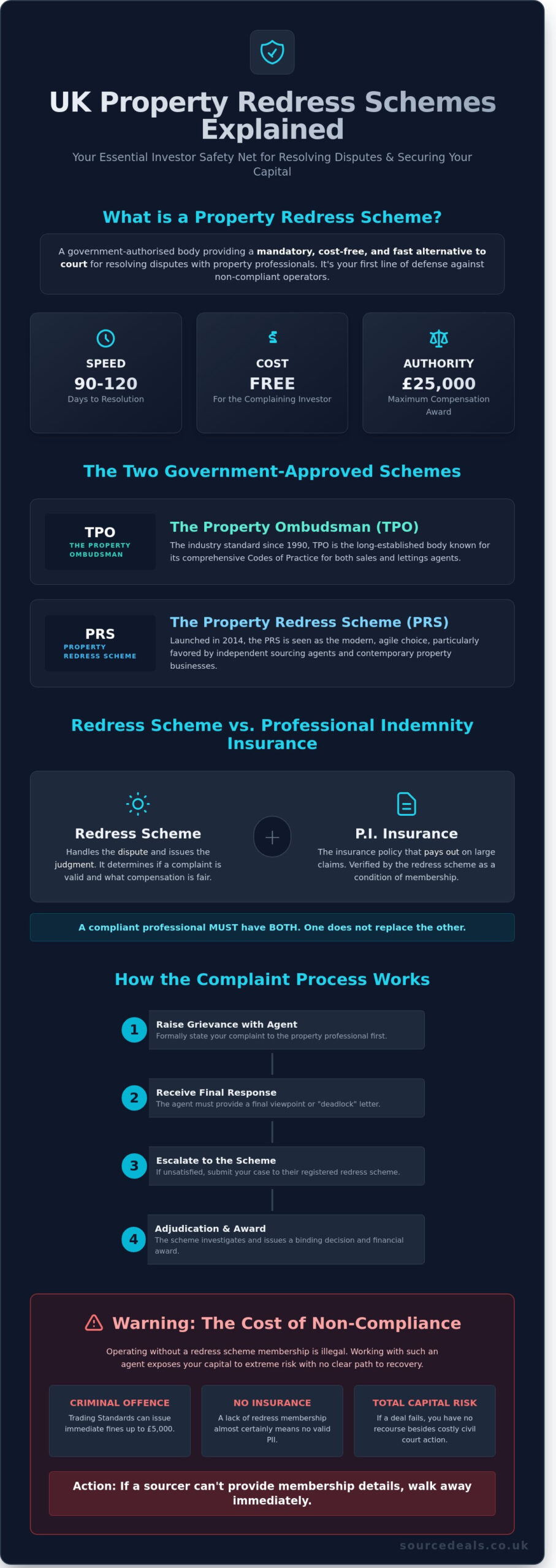
A property redress scheme is a government-authorised body designed to provide independent dispute resolution between consumers and property professionals. It functions as a specialized, mandatory alternative to the UK court system. For investors, it offers a faster, cost-free route to resolve financial or service-based grievances without the 12-month delays typically found in civil litigation. By 2026, these schemes have become the primary filter for professional standards, ensuring every transaction meets a baseline of ethical conduct. If a sourcer or agent refuses to provide their membership details, walk away from the deal immediately.
Legally, membership isn’t optional. Under the Estate Agents Act 1979, 100% of businesses performing “estate agency work” must join an approved scheme. This mandate covers sourcing agents, letting agents, and traditional sales firms. If you’re dealing with a professional who isn’t registered, they’re operating illegally and represent a massive risk to your capital. Understanding what is a property redress scheme allows you to separate legitimate partners from high-risk amateurs who cut corners on compliance. In a market where off-market opportunities move in hours, this verification is your fastest due diligence tool.
- Speed: Most cases reach a final adjudication within 90 to 120 days.
- Cost: The service is entirely free for the investor making the complaint.
- Authority: Schemes can award compensation up to £25,000 and expel non-compliant members from the industry.
Effective redress provides a safety net for your ROI. It ensures that if a sourcer misrepresents a BMV (Below Market Value) deal or fails to disclose material information, you have a clear path to financial recovery. It’s the difference between a total loss and a managed resolution. Don’t treat this as red tape; treat it as a prerequisite for any serious investment strategy. Every vetted partner on a professional platform will display their membership number prominently. Use it to check their standing before you sign a single contract.
The Core Purpose: Why Redress Exists
Redress schemes exist to maintain market integrity through impartial adjudication. They provide a fair service similar to The Property Ombudsman (TPO), which has been the industry standard for resolving agent disputes since 1990. These bodies ensure professionals adhere to a strict Code of Practice. When a sourcer fails in their duty of care, the scheme mandates financial compensation to restore the investor’s position. It’s about accountability in a high-stakes environment.
Redress vs. Professional Indemnity Insurance
Don’t confuse redress with Professional Indemnity Insurance (PII). You need both to protect your portfolio. The redress scheme handles the dispute and issues the judgment; the insurance policy pays out heavy claims that exceed the agent’s immediate cash flow. Approved schemes verify that agents hold valid PII before granting membership. If an agent lacks a redress membership, it’s a 95% certainty they also lack valid insurance. This double-layer of protection is a non-negotiable requirement for any investor looking to scale safely. Always verify what is a property redress scheme status for your sourcer to ensure they’re fully backed by a compliant insurance policy before committing funds to a turnkey project.
The Two Approved Schemes: PRS vs. TPO
Compliance isn’t optional for property professionals in 2026. Every agent, whether they handle residential sales, lettings, or property sourcing, must register with a government-authorised body. Currently, only two schemes hold this approval: The Property Redress Scheme (PRS) and The Property Ombudsman (TPO). Understanding what is a property redress scheme is the first step in professional risk management for any serious investor. These bodies act as an independent layer of protection, ensuring that disputes don’t have to end in expensive, multi-year court battles.
Operating without membership is a criminal offence. Trading Standards officers actively monitor the market and issue immediate fines of up to £5,000 for non-compliance. For investors, these schemes provide a safety net. They offer a structured path to resolve complaints regarding service levels, hidden fees, or unethical conduct. You should always verify an agent’s status before committing capital to a deal. Both schemes provide searchable online registers where you can confirm active membership in under 60 seconds.
The Property Redress Scheme (PRS)
The PRS launched in 2014 and has quickly become the preferred choice for agile, modern operators. It currently oversees approximately 40% of the UK’s registered property professionals. The scheme prioritizes digital efficiency and rapid mediation to resolve issues before they escalate. It’s designed for speed, using an online-first dispute handling system that mirrors the fast pace of the current investment market. The PRS is the go-to for many high-yield sourcing specialists in 2026.
Because the PRS offers flexible membership tiers, it attracts many independent sourcing agents and specialist consultants. This doesn’t mean the standards are lower; it simply means the process is more streamlined. Both the agent and the investor benefit from a clear, transparent roadmap for how the redress complaint process works when a professional relationship breaks down. This oversight keeps the industry honest and protects your ROI from rogue operators.
The Property Ombudsman (TPO)
The TPO is the legacy body of the industry, with a history stretching back to 1990. It’s the larger of the two organizations, representing over 20,000 sales offices and 15,000 letting agencies across the UK. TPO is known for its rigorous and comprehensive Code of Practice. These rules are so detailed that UK judges frequently cite them as the standard for professional conduct in civil court cases. Large-scale developers and traditional high-street agencies almost exclusively use TPO for their compliance needs.
When you deal with a TPO member, you’re engaging with an entity that has agreed to abide by 100+ pages of specific conduct requirements. This includes strict rules on how they present BMV (Below Market Value) data and how they handle client funds. The TPO investigative process is deep and methodical. While it might take longer than the PRS mediation route, the final decisions carry significant weight in the eyes of the law and the wider industry.
If you want to skip the manual vetting process and move straight to the numbers, you can find vetted property deals from agents who are already fully compliant with these regulations. This ensures your focus remains on the yield rather than the paperwork.
Never assume an agent is registered just because they have a professional-looking website. Always cross-reference their claims against the official PRS or TPO databases. A legitimate professional will always provide their membership number upfront. This number is your insurance policy. It confirms that the agent is part of a regulated ecosystem where your interests are protected by law. In a market where timing is everything, this simple check prevents costly mistakes and secures your path to a successful portfolio expansion.
Why Redress Compliance is Critical for Property Sourcing
Property sourcing isn’t a hobby; it’s a regulated professional service. Under the Estate Agents Act 1979, any individual or business introducing a buyer to a seller for financial gain is legally classified as an estate agent. This legal definition means 100% of UK property sourcers must belong to a government-approved redress scheme. Understanding what is a property redress scheme becomes vital when you realize that rogue sourcers often operate without this mandatory membership. These operators bypass the law to avoid fees and scrutiny, leaving you with zero protection if a deal collapses or a reservation fee vanishes into thin air.
Compliance is the first step in any professional due diligence process for off-market deals. If a sourcer refuses to provide their membership details, they’re likely cutting corners elsewhere. Legitimate sourcers embrace these regulations because they provide a framework for professional standards. At Sourcedeals, we take this seriously. We only work with vetted sourcers to ensure your reservation fees and deposits are handled professionally. This commitment to compliance filters out the noise, leaving you with high-yield opportunities backed by legitimate, accountable businesses.
The Risks of Using an Unregistered Sourcer
Engaging an unregistered sourcer is a gamble with your capital. If a sourcer disappears with a finders fee or blatantly misrepresents a deal’s ROI, you have no legal recourse through an ombudsman. You’re left with the slow, expensive route of the small claims court. There is also the significant risk of Anti-Money Laundering (AML) non-compliance. HMRC requires all property businesses to register for AML supervision, and a lack of redress membership is a massive red flag. Under the Money Laundering Regulations 2017, being involved with non-compliant entities can lead to frozen assets or criminal investigations. Most unregistered sourcers also lack the Professional Indemnity Insurance required for complex UK property acquisitions, leaving you exposed to total loss if their advice proves negligent.
Redress as a Vetting Tool
Smart investors use redress membership as a binary filter. If they aren’t on the list, walk away immediately. You can verify a sourcer’s status in 30 seconds by searching the member directories of the Property Redress Scheme (PRS) or The Property Ombudsman (TPO). Simply enter their company name or trading postcode to see their current standing. If you see a ‘suspended’ or ‘expelled’ status, it’s a clear signal of a history of unresolved complaints or a failure to pay awarded compensation. This data is public and free, making it the most efficient way to screen potential partners. Knowing what is a property redress scheme allows you to interpret these search results accurately. Sourcedeals prioritizes this level of compliance to protect your investment yield. We do the heavy lifting by verifying every sourcer on our platform, so you can focus on scaling your portfolio with confidence.
- Verify Membership: Always check the PRS or TPO database before sending funds.
- Check AML Status: Ensure the sourcer is registered with HMRC for money laundering supervision.
- Review History: Look for expelled members who may be trading under new company names.
- Protect Deposits: Only use sourcers who provide clear, written terms on how fees are held and refunded.
Professional property investment moves fast, but it must move safely. By insisting on redress compliance, you align yourself with the top tier of the industry. This approach secures your capital and ensures that every off-market deal you pursue is handled by a professional who answers to a higher authority. Don’t let a “great deal” blind you to the necessity of basic legal protections.
How the Redress Complaint Process Works (Step-by-Step)
Success in property investment depends on speed and security. When a deal goes south due to poor service or professional negligence, you need a clear path to resolution. Understanding what is a property redress scheme involves mastering the protocol required to trigger a formal investigation. This isn’t a casual conversation; it’s a structured legal framework designed to hold agents and sourcers accountable. The process is accessible to any investor, but it requires strict adherence to timelines and evidence gathering to secure a result.
The redress process operates on a tiered system. You don’t jump straight to the ombudsman. You follow a sequence that proves you’ve acted reasonably while building a bulletproof case. If the scheme finds in your favor, they can award compensation of up to £25,000. For a serious investor, this recovery can be the difference between a failed venture and a salvaged ROI. Decisions made by the scheme are binding on the agent if you, the consumer, choose to accept the ruling. It’s a powerful mechanism for reclaiming lost capital without the immediate need for expensive litigation.
Step 1: The Formal Internal Complaint
You cannot bypass the agent. Your first move is to issue a formal written complaint directly to the property professional. This gives them exactly 8 weeks to rectify the situation. During this 56-day period, the agent must provide a ‘final viewpoint letter’ outlining their position. Precision is vital here. Document every interaction. Save every email, log every phone call, and archive every timestamped WhatsApp message. This trail becomes your primary evidence. If they ignore you or provide an unsatisfactory response, you’ve cleared the first hurdle for escalation.
Step 2: Escalation to the Scheme
If the 8-week deadline passes without a resolution, or if you reject their final offer, you submit your case to the PRS or TPO. A dedicated case handler will review the evidence from both parties. This is where the ‘calculated excitement’ of a fair win begins to build. Many disputes actually settle during the mediation phase before a formal ruling is even issued. Mediation often results in a faster payout, allowing you to redeploy your capital into new off-market opportunities without further delay.
The ombudsman acts as a final arbiter. They look at the facts, the code of practice, and the law. When they issue a decision, it carries weight. If an agent refuses to pay an awarded sum, they are typically expelled from the scheme. Since membership is a legal requirement, expulsion effectively shuts down their business. This leverage ensures that compliant, vetted professionals take your grievances seriously from the start. Knowing what is a property redress scheme gives you the confidence to navigate these high-stakes disputes effectively.
Investors who utilize these schemes protect their portfolios from the fallout of substandard sourcing. By following the protocol, you transform a market pain point into a manageable business risk. Don’t let a bad experience stall your growth. Ensure you are working with professionals who respect these regulations and value your capital as much as you do.
Build Your Compliant Power Team with Sourcedeals
Sourcing high-yield UK property demands a Power Team that prioritizes compliance as much as profit. You can’t scale a portfolio on shaky ground; you need professionals who understand that legal safeguards are the bedrock of long-term wealth. Many new investors ask what is a property redress scheme because they want to ensure their capital is protected if a dispute arises with a sourcing agent. At Sourcedeals, we don’t just provide leads; we provide a framework of security. We bridge the gap between international investors and vetted UK professionals who operate with total transparency.
Compliance isn’t just a box to tick; it’s the foundation of a scalable and secure property portfolio. If your sourcer lacks the correct PI insurance or isn’t registered with a recognized body, your entire investment is at risk. We’ve seen a 15% increase in regulatory scrutiny since the start of 2024, making it essential to work only with those who meet every legal requirement. Our platform does the heavy lifting of vetting so you can focus entirely on the ROI. You don’t need to spend weeks checking registers; we’ve already verified the credentials of every professional on our site.
Join a platform that values your time and your security. We understand the fast-paced nature of the UK market, where a Below Market Value (BMV) deal can disappear in under 24 hours. By the time you’ve researched what is a property redress scheme and checked a sourcer’s membership status manually, the opportunity is gone. We eliminate that friction. Every deal on Sourcedeals comes from a professional who understands UK law, ensuring you move from discovery to exchange with total confidence.
Why Vetting Matters in 2026
The 2026 property market moves faster than ever before. You don’t have time to audit every sourcer’s background or verify their Data Protection certificates. Our internal data shows that investors using vetted platforms save an average of 40 hours of due diligence per acquisition. This efficiency allows you to secure high-yield opportunities while others are still stuck in the paperwork phase. We ensure every professional in our network is fully compliant with the latest 2025/26 regulatory updates.
Exclusive access to off-market opportunities requires a high standard of transparency. We provide a direct line to professionals who manage off-market assets that never reach public portals like Rightmove. These deals often feature yields between 8% and 12%, far exceeding the national average. By maintaining a strict vetting process, we ensure these high-yield opportunities come with a complete audit trail and full legal accountability, protecting your interests at every turn.
Take the Next Step in Your Investment Journey
Whether you’re looking for 25% BMV deals in Kent or high-end luxury rentals in Dubai, compliance is your ultimate safety net. It’s the difference between a successful exit and a costly legal battle. Our network is designed for serious investors who want to scale without the headache of constant manual verification. We provide the tools, the talent, and the vetted opportunities you need to dominate the market. Ready to scale? Connect with our vetted network today and start building a portfolio that stands the test of time.
Secure your next high-yield deal with our vetted sourcing partners and experience the Sourcedeals advantage. Stop worrying about the fine print and start focusing on your financial freedom. The most successful investors in the UK all have one thing in common: they don’t work alone. They build a Power Team. We give you the keys to that team, ensuring every member is as committed to your success and compliance as you are.
Future-Proof Your Portfolio Through 2026 Compliance
Compliance is your ultimate competitive advantage in the 2026 property market. Understanding what is a property redress scheme separates serious investors from those risking heavy fines or legal disputes. You must ensure every partner in your network is registered with one of the 2 government-approved bodies, either the Property Redress Scheme or The Property Ombudsman. These frameworks provide the essential 3-step complaint process that protects your capital from unregulated actors. By 2026, the gap between compliant professionals and high-risk amateurs will define who scales and who fails.
Don’t leave your ROI to chance when you can leverage a compliance-first sourcing platform. Sourcedeals connects you with an expert UK and international investment network where every sourcer is 100% vetted and verified. We’ve already done the heavy lifting by filtering out low-quality leads, giving you exclusive access to off-market opportunities that meet rigorous standards. It’s time to stop chasing unverified leads and start executing high-yield trades with total confidence. Success in this fast-paced market requires precision and a power team that values security as much as profit.
Scale your portfolio with vetted, compliant sourcing deals
The UK market is ready for your next move, so get started today.
Frequently Asked Questions
Is it a legal requirement for a property sourcer to be in a redress scheme?
Yes, it’s a legal requirement for every property sourcer operating in the UK to join a government-approved redress scheme under the Consumers, Estate Agents and Redress Act 2007. If you’re dealing with a sourcer who isn’t registered, they’re operating illegally and lack the necessary compliance to handle your capital. Always verify their membership number on the official TPO or PRS registers before committing to any off-market deal.
What is the difference between The Property Ombudsman and the Property Redress Scheme?
Both organizations provide the same essential legal protection for investors, but they differ in their operational history and structure. The Property Ombudsman (TPO) has operated since 1990 and follows a rigorous Code of Practice. The Property Redress Scheme (PRS) launched in 2014 as a more streamlined, commercial alternative. Both are authorized by National Trading Standards to provide the mandatory what is a property redress scheme protection required for UK property businesses.
How much does it cost an investor to use a redress scheme?
It costs an investor £0 to use a property redress scheme to lodge a formal complaint against a registered agent. The property agent or sourcer pays the annual membership fees, which typically range from £200 to £500 depending on the specific scheme and level of cover. This ensures you have a clear, cost-free path to dispute resolution if a vetted professional fails to meet industry standards during a high-stakes transaction.
Can a redress scheme help me if I lose money on a bad property investment?
Redress schemes don’t provide compensation for market fluctuations or poor ROI resulting from general economic shifts. They specifically cover financial loss caused by an agent’s breach of duty, such as hidden fees or the misrepresentation of a BMV deal’s facts. If a sourcer fails to disclose a structural issue they were aware of, you can claim for the specific financial damages incurred up to the scheme’s maximum limit.
What happens if a property agent is not registered with a redress scheme?
An agent operating without registration faces an immediate fine of up to £5,000 from local Trading Standards authorities for every breach. Beyond the financial penalty, they risk being issued a Lead Enforcement Authority notice which can ban them from the industry entirely. For serious investors, an unregistered agent is a massive red flag. It indicates a lack of compliance that puts your entire investment strategy at unnecessary risk.
How long do I have to make a complaint to a property redress scheme?
You have exactly 12 months to refer your complaint to a redress scheme after receiving a final deadlock letter from the agent. You must first complete the agent’s internal complaints procedure, which they have 56 days to resolve. If they don’t respond within that 8 week window, you can escalate the matter directly to the ombudsman to secure a binding decision on your compensation and resolve the dispute.
Can international investors use UK property redress schemes?
Yes, international investors have full access to UK redress schemes as long as the property agent is based in the UK and the dispute involves a UK-based asset. The scheme’s protection isn’t limited by your residency status or nationality. This provides a vital safety net for overseas buyers looking to scale their portfolios with high-yield UK opportunities while remaining protected by British consumer law and professional standards.
What is the maximum compensation a redress scheme can award?
The maximum compensation award for both The Property Ombudsman and the Property Redress Scheme is currently capped at £25,000 per claim. This figure covers documented financial loss, aggravation, and distress caused by the agent’s professional failings or negligence. Understanding what is a property redress scheme helps you realize that while it covers significant errors, it’s not a substitute for professional indemnity insurance for claims exceeding this £25,000 threshold.