
By 2026, anchoring your capital to a single UK postcode isn’t just conservative; it’s a blueprint for 3.5% yield stagnation. Serious investors recognize that over-concentration is the fastest way to see wealth erode when local regulations or economic shifts occur. To stay ahead, you must build a diversified property portfolio that captures growth across multiple sectors and international borders, moving beyond the limitations of traditional domestic portals.
You’ve likely noticed that the old “buy-to-let” standby is failing to deliver the 10% plus ROI you require, all while management headaches consume your professional time. This guide changes that. We’ll show you exactly how to insulate your capital by targeting off-market opportunities in emerging hubs and high-demand commercial niches. You’ll learn the data-driven framework for vetting international deals and implementing turnkey systems that ensure your portfolio remains resilient and profitable without the operational drag of daily management.
Key Takeaways
- Learn to insulate your wealth by moving beyond traditional UK Buy-to-Let into more resilient property sectors.
- Discover the strategic framework needed to build a diversified property portfolio that balances geographic stability with high-growth international markets.
- Compare stable UK security against high-ROI emerging markets like Egypt and Indonesia to maximize your total yields.
- Professionalize your operations by identifying the essential power team roles required to scale your portfolio without the “solopreneur” burnout.
- Unlock exclusive access to vetted, off-market opportunities and turnkey management solutions to accelerate your investment journey.
What is a Diversified Property Portfolio and Why is it Essential?
Investors often mistake owning multiple units for true security. If those units are all terraced houses in a single UK postcode, you aren’t protected; you’re exposed. A diversified property portfolio requires spreading capital across different locations, property types, and investment strategies. This approach ensures your ROI isn’t tied to the fate of a single local economy or a specific tenant demographic.
Relying solely on traditional UK Buy-to-Let is a high-risk strategy in 2026. With the cumulative impact of Section 24 tax changes and the 2024 Renters’ Reform Bill, margins on standard rentals have tightened significantly. If interest rates hover around the 5% mark, a single-market strategy leaves you vulnerable to legislative shifts and regional downturns. Savvy investors apply the financial principle of diversification to ensure that a 10% dip in one sector doesn’t sink their entire net worth. Risk mitigation isn’t about avoiding danger; it’s about making sure different markets react independently to economic shifts.
The ultimate goal is a strategic balance. You want high-yield assets to drive monthly cash flow alongside stable assets that promise long-term capital appreciation. By mixing off-market BMV (Below Market Value) deals with turnkey residential units, you create a resilient financial structure. This balance allows you to weather interest rate hikes while still extracting maximum value from high-growth corridors.
The Core Benefits of Real Estate Diversification
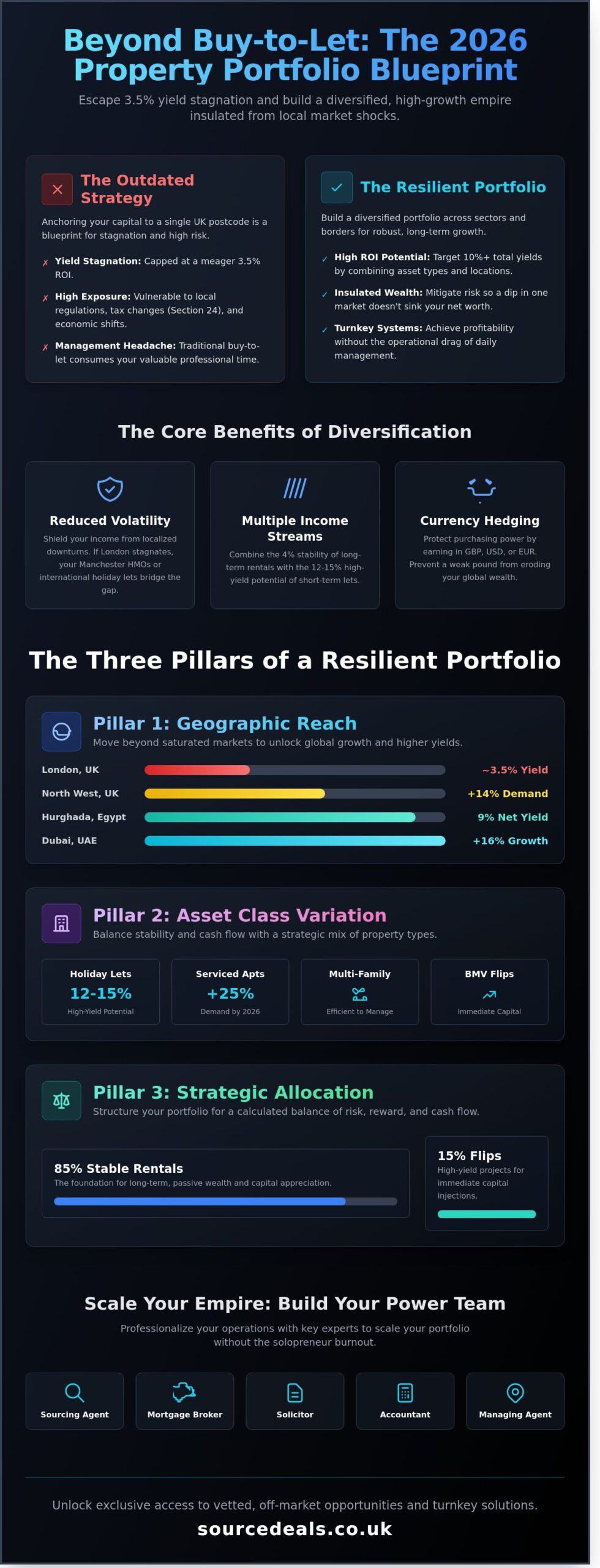
- Reduced volatility: Shield your income from localized market downturns. If the London residential market stagnates, your Manchester HMOs or coastal holiday lets can bridge the gap.
- Multiple income streams: Combine the 4% stability of long-term family rentals with the 12% to 15% high-yield potential of short-term holiday lets.
- Currency hedging: Protect your purchasing power by earning in GBP, USD, or EUR. Holding assets in different currencies prevents a weak pound from eroding your global wealth.
Common Misconceptions About Diversifying
Don’t believe the myth that you need £2 million in the bank to start. You can scale a diversified property portfolio incrementally by reinvesting profits from off-market flips or using bridge financing to secure high-yield assets. The entry point is often lower than most beginners realize, especially when targeting vetted, high-yield opportunities outside of the South East.
Modern management tools have killed the idea that a spread-out portfolio is too hard to manage. Software like Arthur Online or Appfolio allows you to oversee twenty properties across three countries from a single dashboard. Efficiency is now a choice, not a barrier. Furthermore, international investing isn’t inherently riskier than domestic. A vetted, compliant overseas development in a transparent market often carries less risk than an unvetted UK project with hidden structural issues or poor local demand. Precision and data always beat geographical proximity.
The Three Pillars of a Resilient Property Portfolio
Building a diversified property portfolio requires more than just buying multiple assets. It demands a calculated distribution of risk across three distinct areas. You must understand the “Capital Stack” logic. This means knowing where your money sits in the hierarchy of repayment. Senior debt is the safest; common equity is the most rewarding. Balance is the goal. Aim for a mix of 15% high-yield flips for immediate capital injections and 85% stable rentals for passive wealth. This ensures you aren’t over-leveraged in one specific phase of the investment lifecycle.
Pillar 1: Geographic Reach
Stop obsessing over London. The South East is saturated; yields there often struggle to top 3.5% as of June 2024. Look toward the North West. Manchester and Liverpool saw a 14% increase in rental demand in the 12 months leading to May 2024. Go further. Hurghada, Egypt, currently offers 9% net yields due to a massive surge in European tourism and low entry costs. Dubai’s luxury sector grew by 16% in 2023; it remains a powerhouse for tax-free growth. Southeast Asia is also prime. Vietnam’s urban population is growing by 3% annually. This creates a massive supply-demand gap. Always vet the local infrastructure projects before committing capital. If the 2025 pipeline shows 5,000 new units but demand is only 2,000, move on immediately. Geographic spread protects you from localized economic downturns and policy changes.
Pillar 2: Asset Class Variation
Single-family homes are easy to sell. Multi-family blocks are easier to manage at scale. You need both. The 2026 market will see a 25% increase in demand for serviced apartments. Digital nomads want turnkey living. These units often generate 45% more revenue than standard long-term lets. Commercial property adds another layer of security. A 15-year “Full Repairing and Insuring” (FRI) lease with a blue-chip tenant provides “sleep-easy” income. Using proven Real Estate Portfolio Diversification Strategies prevents a single market dip from wiping out your gains. Don’t put all your capital into residential ASTs. Mix in some commercial or industrial units to hedge against changes in residential rental legislation.
For those with a global outlook, even more specialized asset classes exist, such as the equestrian estates and ranches found through niche specialists like Colorado Horse Property, which can offer unique growth potential completely uncorrelated with standard residential markets.
Pillar 3: Strategy Diversification
Don’t get stuck in one lane. High-yield flips generate the cash you need for larger deposits. Buy BMV (Below Market Value) assets; refurbish; refinance; repeat. This BRRR method is the engine of growth. Combine this with long-term passive income from HMOs or commercial units. This hybrid approach ensures you have cash for today and wealth for tomorrow. By January 2025, the most successful investors will be those who balanced 20% “active” projects with 80% “passive” holds. This ratio keeps your portfolio liquid while building equity. If you want to scale fast, you need access to the right stock. You can view our latest off-market opportunities to find high-yield assets that fit this strategy. Every deal we host is vetted for ROI potential, helping you build a diversified property portfolio with total confidence.
A resilient portfolio isn’t built on luck. It’s built on data. By spreading your bets across different cities, asset types, and exit strategies, you insulate yourself from volatility. You’re not just a landlord; you’re an asset manager. Treat your portfolio like a business. Track the yields. Monitor the vacancy rates. Rebalance when necessary. The “Capital Stack” approach ensures that even if one project stalls, the others provide the liquidity to keep you moving forward. This is how professional investors stay profitable in every market cycle.
UK vs. International Real Estate: Finding the High-Yield Sweet Spot
Professional investors don’t put all their capital into a single market. Building a diversified property portfolio requires a strategic balance between the battle-tested security of the UK and the explosive growth of international hubs. The UK offers a gold-standard legal framework and high levels of liquidity. However, recent 2024 tax changes and the upcoming Renters’ Rights Bill have squeezed margins for casual landlords. Savvy investors are pivoting. They use the UK for capital preservation while chasing double-digit yields in emerging markets.
A 70/30 split between domestic and international assets is the current benchmark for optimizing risk-adjusted returns. By keeping 70% of your assets in UK residential or commercial property, you maintain a stable foundation in a hard currency. The remaining 30% goes into high-growth regions like Egypt or Indonesia where entry costs are often 65% lower than UK equivalents. This strategy aligns with the principles of sound investing by spreading exposure across different economic cycles and regulatory environments. It ensures that a policy change in one country won’t cripple your entire wealth strategy.
Dubai remains a powerhouse anchor for any serious diversified property portfolio. With 0% tax on rental income and capital gains, it provides a level of friction-less profit that the UK cannot match. While London yields average 3.8% in 2024, Dubai Marina regularly delivers 7% to 9% net. The city’s world-class infrastructure and 2040 Urban Master Plan signal long-term stability. It’s about the data. If your goal is immediate cash flow, you must look where the numbers work hardest.
The Case for UK Property Sourcing
Profits are made when you buy, not when you sell. High-yield regions like the North West and Kent remain lucrative if you can bypass the open market. We focus on securing off-market deals at 15% to 20% Below Market Value (BMV). This locks in instant equity from day one. In 2024, cities like Manchester and Liverpool continue to outperform the South East in rental growth. You need vetted, compliant leads to win in this competitive space. Check our property sourcing services UK to access exclusive deals that never hit the public portals.
Tapping into International Vacation Rentals
Hurghada is currently a top-tier destination for investors seeking sun and yield. The logic is simple: a 12-month peak season. Unlike Mediterranean locations that see a massive drop-off in winter, Egypt stays active year-round. This climate consistency pushes occupancy rates above 75% for premium units. Higher occupancy directly translates to superior ROI. Managing these assets from abroad used to be a barrier, but turnkey solutions have removed the friction. Explore vacation rental management Hurghada to start earning passive international income with zero daily hassle.
Successful diversification isn’t just about buying more property. It’s about buying the right property in the right jurisdiction at the right time. Use these metrics to guide your next move:
- UK: Focus on 15%+ BMV deals for equity growth.
- Dubai: Target 8% net yields for tax-free cash flow.
- Egypt: Leverage low entry costs for high-yield vacation lets.
Stop waiting for the “perfect” market conditions in one country. They don’t exist. Spread your risk, capture global growth, and secure your returns through a multi-jurisdictional approach.
Scaling Your Empire: Building Your Property Power Team
You won’t reach a £10 million valuation by acting as a solopreneur. The “do-it-all” approach works for your first buy-to-let, but it fails when you scale a diversified property portfolio. Serious growth requires a shift from being a landlord to becoming a CEO. You need to delegate the technical heavy lifting to specialists who live and breathe the UK market. This means hiring conveyancers who can exchange in 21 days rather than the industry average of 90. It means working with tax advisors who understand the nuances of Section 24 and how to structure Limited Company SPVs to protect your margins.
Remote management is the only way to maintain a footprint across multiple regions. In 2024, 82% of successful portfolio landlords use cloud-based management software to track yield and rent collection in real time. These tools allow you to monitor a social housing project in Birmingham and an HMO in Manchester from a single dashboard. You don’t need to be local if your tech stack is robust. High-energy investors use automation to handle maintenance tickets and compliance alerts, ensuring no property becomes a liability.
The Sourcing Advantage
Professional sourcing agents are the gatekeepers to the best deals in the UK. They find off-market opportunities that never reach Rightmove or Zoopla. When a sourcer presents a deal, they’ve already completed a 12-point due diligence process. This includes verifying comparable sold prices from the last 18 months, checking Article 4 directions, and confirming the building’s EPC rating meets 2025 standards. You pay for their boots-on-the-ground expertise. Most vetted sourcers charge a fixed success fee between £2,500 and £5,000, or a 2% commission on the purchase price. This cost is a small price to pay for securing a property at 15% below market value.
Coaching and Mentorship for Growth
Even seasoned investors use real estate coaching to break into unfamiliar asset classes. Moving from standard residential lets into commercial-to-residential conversions requires a different mental framework. A mentor helps you master the “15-minute filter,” a technique used to analyze a deal’s viability before the competition even opens the brochure. This speed is vital in a market where the best BMV deals are snapped up within hours of being listed. Discover our real estate investment coaching programs to sharpen your acquisition strategy and avoid the expensive pitfalls of unvetted leads.
Success in property isn’t about working harder; it’s about building a machine that works for you. By leveraging a power team, you remove yourself as the bottleneck and allow your capital to deploy at speed. You focus on the strategy while your team handles the tactics. This is how you transition from owning a few houses to controlling a dominant market presence.
Ready to find your next high-yield opportunity? Access our vetted off-market deals now.
How Sourcedeals.co.uk Streamlines Your Diversification Strategy
Building a diversified property portfolio requires more than just capital; it demands boots-on-the-ground intelligence and immediate access to restricted markets. Sourcedeals.co.uk functions as your high-speed gateway to these opportunities. We bridge the gap between ambitious investors and high-yield assets that never reach the open market. Since our 2021 expansion, we’ve facilitated over £50 million in off-market transactions, focusing on speed, precision, and verified data.
- Exclusive Off-Market Access: We provide direct leads on Below Market Value (BMV) properties across the UK and high-growth international hubs like Egypt and Dubai. These aren’t recycled portal listings; they’re fresh, vetted opportunities sourced through our private network.
- End-to-End Acquisition Support: Our service doesn’t stop at the lead. We assist with the entire lifecycle, from initial sourcing and due diligence to the final acquisition and subsequent vacation rental management.
- Passive Income Infrastructure: Forget the stress of manual oversight. We offer transparent digital reporting and remote rent collection. You can track your ROI from any device, anywhere in the world, with 24-hour access to your performance metrics.
- Rigorous Compliance: Security is our baseline. Every deal on our platform passes a strict 12-point verification process. We ensure every sourcer is fully compliant with UK regulations, protecting your capital from unregulated risks.
Our platform is built for the serious professional who values time as much as yield. We’ve distilled complex market data into actionable insights, allowing you to make move-forward decisions in minutes rather than weeks. By removing the traditional barriers to international entry, we make global scaling a reality for UK-based investors. To ensure you’re tracking the right numbers for maximum profitability, our comprehensive guide on real estate portfolio metrics provides the exact data points you need to optimize your international holdings and avoid the vanity numbers that waste your time.
Our Global Reach, Your Local Advantage
Success in overseas markets depends on “insider” knowledge. We leverage local experts in Hurghada, Dubai, and Berlin to identify emerging hotspots before they peak. In Hurghada, for example, our partners have secured gross yields of 12% to 15% on luxury beachfront apartments. We handle the “Three Ts” (Toilets, Tenants, and Trash) through professional, localized management teams. This ensures your international assets remain hands-off and high-performing. We connect serious investors with high-yield, off-market property gems across three continents.
Take the Next Step Toward a Global Portfolio
Don’t let market volatility stall your growth. Diversification is the only proven hedge against localized economic shifts. Whether you’re looking for a turnkey HMO in the North of England or a high-spec short-let in Dubai’s Marina, the first step is strategy. Book a strategy call with our team to map out your specific diversified property portfolio goals and risk appetite. You’ll also gain the option to join our exclusive investor list, giving you a 48-hour head start on every new deal that hits our desk. The most lucrative opportunities move fast; make sure you’re positioned to move with them.
Start building your diversified property portfolio today with Sourcedeals.co.uk. High-yield, vetted, and completely off-market. Your next acquisition is waiting.
Take Command of Your Investment Future
Building a diversified property portfolio is the only way to insulate your capital against market volatility in 2026. You’ve learned that true resilience comes from balancing stable UK assets with high-yield international opportunities in emerging hubs like Hurghada and Dubai. Relying on public portals is a losing game. The real profit sits in exclusive, off-market deals that most investors never see. Success in this fast-paced environment requires a power team that prioritizes data over sentiment.
Sourcedeals.co.uk provides the streamlined infrastructure you need to scale. We deliver 100% vetted leads and professional coaching to ensure every move you make is backed by compliance and high-performance metrics. With our expert management teams handling your turnkey assets in Dubai and Hurghada, you can focus on high-level strategy rather than daily maintenance. Don’t settle for average returns when 15% yields are within reach through verified BMV sourcing. It’s time to stop searching and start securing assets that move the needle.
Secure your next high-yield property deal with Sourcedeals.co.uk
The market waits for no one, so take the first step toward your most profitable year yet.
Frequently Asked Questions
How many properties do I need for a truly diversified portfolio?
You need between five and ten distinct properties to achieve a truly diversified property portfolio. Holding just two or three assets leaves you dangerously over-exposed to local market shifts or single-tenant defaults. Aim for a strategic 40/60 split between capital appreciation plays in emerging zones and high-yield rental units in established hubs. This volume ensures you maintain consistent cash flow even if one market underperforms.
Is it better to diversify by location or by property type first?
Diversify by location first to insulate your capital from regional economic downturns. Data from the 2023 UK House Price Index showed that while London prices dipped by 4.8%, the North West saw 3.5% growth. Spreading your investments across different postcodes prevents a single local council policy from devaluing your entire holding. Once you have three different locations secured, start mixing asset classes like HMOs or turnkey commercial units.
What are the biggest risks of international property investment?
Currency volatility and lack of legal transparency are the primary risks for overseas investors. A 12% shift in exchange rates can instantly wipe out your annual rental yield before you’ve paid a single bill. You must also navigate foreign ownership laws, such as the specific freehold regulations in the UAE. Always use vetted, local legal counsel to verify title deeds and ensure every deal is 100% compliant with local statutes.
How much capital is required to start diversifying overseas?
You generally need a minimum of £50,000 in liquid capital to start diversifying into international markets like Dubai or Egypt. While some off-plan deals in Hurghada start as low as £30,000, you should budget for a 25% to 30% deposit plus 5% for closing costs. This entry point allows you to secure high-quality, turnkey assets that generate immediate ROI without overleveraging your primary UK holdings.
What is the best way to manage properties in different time zones?
Appoint a professional, local management company to handle all daily operations and tenant communications. Trying to manage a property in a time zone that’s 4 hours ahead of yours leads to missed maintenance issues and high tenant turnover. Most reputable firms charge between 8% and 12% of the monthly rent. This small deduction from your yield ensures your diversified property portfolio remains passive and your assets stay in peak condition.
Can I use a UK mortgage to buy investment property in Egypt or Dubai?
You cannot use a standard UK mortgage to purchase property in Egypt or Dubai because UK lenders won’t secure a charge against foreign titles. You must instead secure an international mortgage or use a local lender in the target country. Banks in the UAE typically offer non-residents a 50% Loan-to-Value (LTV) ratio. Alternatively, many savvy investors use a bridge loan or equity release from their UK portfolio to fund these cash purchases.
How do I handle taxes on a diversified international portfolio?
You must report all global income to HMRC while utilizing Double Taxation Agreements (DTAs) to ensure you don’t pay tax twice on the same profit. The UK currently has treaties with over 130 countries, including the UAE and Egypt, to prevent dual taxation. Hire a tax professional who understands the Statutory Residence Test. They’ll ensure you maximize your ROI by correctly applying for foreign tax credits on your annual self-assessment.