
What if the biggest threat to your 12% ROI in the Red Sea isn’t the market, but a misunderstood tax filing? You know that Egyptian real estate offers some of the most lucrative off-market opportunities in 2026. However, the fear of hidden bureaucracy and the EGP versus USD valuation gap often stalls high-value moves. Mastering property taxes in egypt for foreigners is the difference between a secure asset and a costly legal headache.
We’ve vetted the latest 2026 regulations to give you a clear, percentage-based roadmap for your next acquisition. You’ll master the 2.5% real estate disposal tax, identify the EGP 2 million exemption threshold for primary residences, and gain total confidence in the Green Contract registration process. This breakdown moves you past the uncertainty of Power of Attorney deals and into a position of verified legal compliance. This guide ensures your capital remains protected while you scale your international portfolio with precision and speed.
Key Takeaways
- Master the 2.5% Real Estate Disposal Tax (REDT) and clarify which party pays to keep your acquisition costs predictable.
- Navigate the specific rules for property taxes in egypt for foreigners, including the 10% annual levy and the critical EGP 2 million exemption threshold.
- Protect your ROI by calculating the 2.5% capital gains tax on resale to ensure your exit strategy remains highly profitable.
- Build a compliant “power team” of vetted local experts to handle “Green Contract” registrations and keep your portfolio legally watertight.
- Optimize your rental yields by identifying the specific tax obligations for vacation lets and short-term investment properties.
Understanding the Egyptian Property Tax Framework
Egypt’s real estate sector is currently undergoing a massive digital transformation, making it a prime target for high-yield seekers. Law No. 196 of 2008, commonly known as the Real Estate Tax Law, serves as the primary legislative bedrock for all property holdings. This law shifted the focus from old, rent-controlled valuations to a more modern system based on actual property characteristics. For serious investors, mastering property taxes in egypt for foreigners starts with recognizing that the taxman views the “owner” or the “usufructuary” as the primary debtor. If you hold the deed or the right to use and profit from the site, you’re responsible for the bill.
The year 2026 represents a critical deadline for the Egyptian Ministry of Finance. By this date, the government aims to have every square meter of taxable land integrated into a centralized digital registry. This move toward transparency removes the “grey areas” that previously allowed some assets to fly under the radar. Investors must ensure their holdings are vetted and registered within the new electronic system to avoid steep penalties or blocks on future title transfers. Compliance isn’t just a legal hurdle; it’s a prerequisite for securing your ROI in a competitive market.
The Two Pillars: Real Estate Tax vs. Registration Fees
Investors often confuse annual levies with one-time transaction costs. The annual tax, locally called “Awayed,” is a recurring 10% charge on the net annual rental value of the property. This is distinct from the Real Estate Publicity Department (REPD) fees. The REPD is the body that verifies your ownership and secures your legal standing. Foreigners must deal with both entities separately. While the REPD handles the initial “entry” into the market through registration fees, the Tax Authority manages the ongoing “stay” via annual payments. Failing to distinguish between these two can lead to unexpected liens on your asset.
Current Market Dynamics and Currency Impact
Currency fluctuations play a massive role in your 2026 tax strategy. The Egyptian Pound (EGP) exchange rate directly dictates the “real cost” of your tax liability when converted from GBP or USD. The Egyptian Ministry of Finance assesses property value by applying a standardized formula to the property’s location, building quality, and utility access to determine a theoretical annual rental yield. This “taxable value” is a fiscal construct and rarely mirrors the actual market price you paid. Because the government re-evaluates these benchmarks every five years, the 2026 cycle will reflect the significant inflationary shifts seen in the mid-2020s. Smart investors track these cycles to predict property taxes in egypt for foreigners and adjust their portfolio yield projections accordingly. Knowing the difference between what a buyer pays and what the state taxes is vital for maintaining a lean, profitable operation.
- Law 196 of 2008: The mandatory framework for all real estate assets.
- Digital Registration: The 2026 hard deadline for electronic filing.
- The 10% Rule: The standard rate for annual property tax after specific deductions.
One-Time Purchase Taxes and Closing Costs
Securing a high-yield asset in Egypt requires more than just capital; it demands a precise understanding of entry costs. While the Egyptian market offers exceptional BMV opportunities, failing to account for closing fees can erode your initial ROI. These one-time costs ensure your asset is legally compliant and fully protected under Egyptian law. You’ve got to factor these into your cash flow projections from the start.
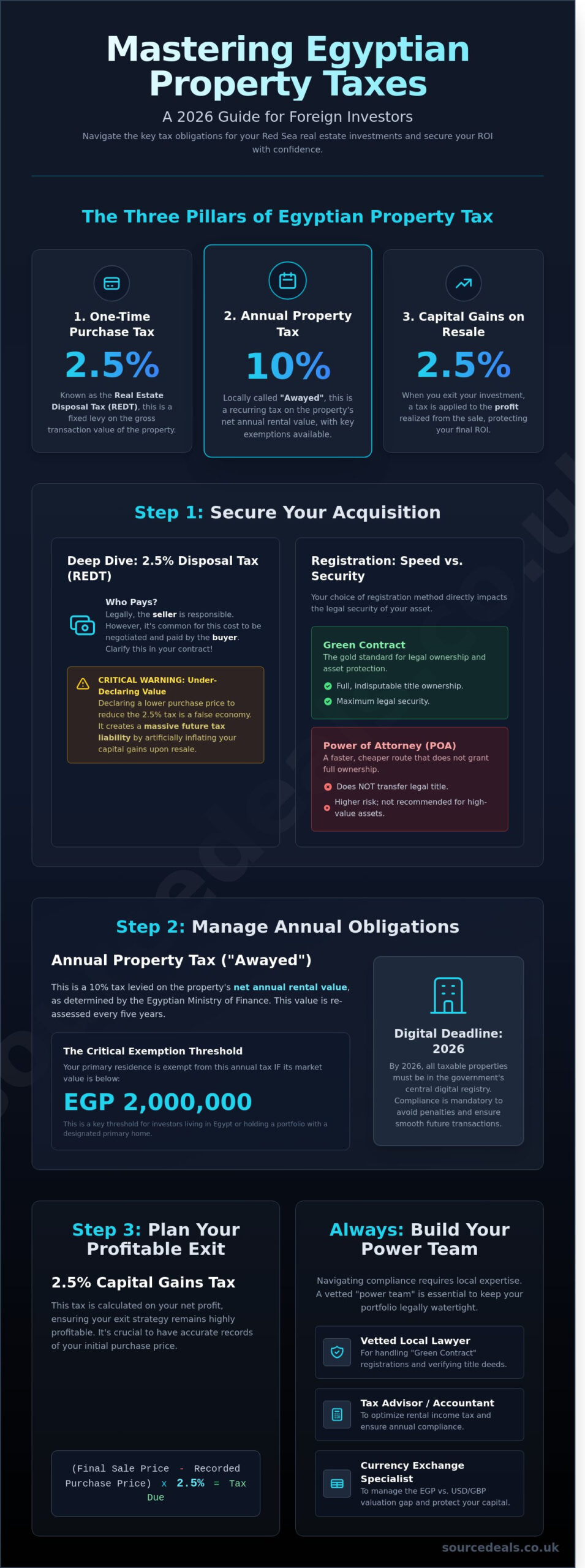
The 2.5% Real Estate Disposal Tax Explained
The Real Estate Disposal Tax (REDT) is a fixed 2.5% levy on the gross transaction value. Under Law No. 158 of 2018, the seller is legally responsible for this payment. However, in the fast-paced Egyptian market, sellers frequently bake this cost into the final purchase price or negotiate for the buyer to cover it during the closing process. You must clarify this in the initial contract to avoid surprise liabilities at the point of transfer.
- Exemptions: First-time transfers from developers in New Urban Communities often bypass this specific tax. In these zones, the developer handles corporate tax obligations separately.
- Audit Risks: Never under-declare the purchase price on official documents. While some attempt this to reduce the 2.5% fee, it creates a massive risk for property taxes in egypt for foreigners when you eventually exit the investment. A lower recorded buy-price results in a significantly higher capital gains liability later.
Registration Costs: Green Contract vs. Power of Attorney
Investors must choose between speed and security. A Power of Attorney (POA) is the quickest route, often costing less than $150 for notary fees, but it doesn’t grant full title ownership. For maximum security, aim for the Green Contract. This is the gold standard for investment protection in 2026. While the official government registration fee is capped at 3,900 EGP for units up to 300 square meters, the total legal spend usually hits $1,500 to $2,500 once you factor in document legalization at the Egyptian Consulate.
The “Signature Validity” (Sihha wa Nafaz) process is a middle-ground court route. It typically costs 1.5% of the property value in combined legal fees and court stamps. This process confirms the seller’s signature is authentic, providing a layer of protection that a simple POA cannot match. If you want to scale your portfolio safely, you should always partner with vetted legal experts who understand these nuances.
Administrative fees and stamp duties add another 0.5% to 1% to your total closing costs. These include small charges for the Bar Association fee and technical survey costs required for the final registration. Budgeting a total of 5% to 7% of the purchase price for all closing costs ensures your 2026 acquisition remains profitable and secure. Understanding property taxes in egypt for foreigners early in the process prevents these essential costs from becoming unexpected hurdles.
Annual Real Estate Tax (Awayed) and Exemptions
Owning assets in Egypt requires a clear understanding of the “Awayed,” the annual real estate tax. The Egyptian government levies a 10% tax on the net annual rental value of all buildings. This isn’t a tax on your actual rental income. Instead, a local committee assesses the property’s potential rental value every five years. The current assessment period remains active through December 2026. This system ensures a steady revenue stream for the state while providing investors with a predictable overhead cost.
The law provides an automatic deduction to account for upkeep. Residential property owners receive a 30% deduction from the gross rental value for maintenance. Commercial owners get a 32% deduction. These figures are fixed. You don’t need to provide receipts or proof of repairs to claim them. It’s a streamlined process designed to simplify property taxes in egypt for foreigners and locals alike.
Deadlines are strict. You must pay the annual tax in two equal installments. The first deadline is June 30 and the second is December 31. Missing these dates is a costly mistake. Late payments incur an interest rate calculated based on the Central Bank of Egypt’s discount rate plus an additional 2%. Secure your ROI by automating these payments through your legal representative in Cairo or Hurghada.
The Exemption Threshold for Foreigners
The EGP 2 million exemption is the most misunderstood rule for international investors. You can exempt one residential unit from tax if its total value is below EGP 2 million. However, this only applies if the unit is your primary residence. Most investors buying in Red Sea resorts find their properties classified as secondary homes. Your second or third property in Hurghada will always be taxed, regardless of its value. To apply for a primary residence exemption in 2026, you must submit a formal request to the Egyptian Tax Authority. You’ll need a registered contract, utility bills in your name, and a copy of your residency permit.
The Calculation Formula
The government uses a specific sequence to reach your final bill. They start by determining the market value and then derive the “Gross Rental Value” at roughly 3% of that total. The net annual rental value is the estimated gross yearly rent minus the statutory maintenance deduction of 30% for residential units or 32% for non-residential units. This net figure is the taxable base. For property taxes in egypt for foreigners, the rates differ significantly by property type. Residential units pay 10% on the net value. Commercial properties, such as retail units in New Cairo, also face a 10% rate but often deal with higher initial valuations and lower exemptions. Always verify the government’s valuation of your unit to ensure you aren’t overpaying based on outdated market data.
Rental Income Tax and Capital Gains for Foreigners
Generating a high yield requires more than just high occupancy; it demands a clinical understanding of your net obligations. Egypt offers a favorable environment for landlords who know how to structure their holdings. When calculating property taxes in egypt for foreigners, the rental income tax stands out for its simplicity. The Egyptian Tax Authority allows a standard 50% deduction from your gross rental income to cover all operating expenses. You only pay tax on the remaining 50% at a progressive rate, typically starting at 10% for the lowest brackets. This structure protects your cash flow from being eroded by complex accounting requirements.
Taxing Your Vacation Rental Income
Short term lets via platforms like Airbnb or Booking.com are now strictly monitored by the Ministry of Finance. If you’re operating a high turnover unit in a prime coastal spot, you must register for a tax file. Small scale landlords often benefit from a simplified regime that avoids the 14% VAT unless annual turnover exceeds 500,000 EGP. To ensure your numbers stack up, you should maximize your Hurghada rental ROI with professional management. Professional firms handle the compliance and reporting so you don’t have to manage local bureaucracy from abroad.
Commercial portfolios or large scale residential blocks face different rules. If you own a building with more than a few units, the 14% VAT becomes a mandatory consideration for commercial leases. However, the UK-Egypt Double Taxation Convention of 1980 remains your strongest shield. This treaty ensures that tax paid in Egypt is credited against your UK liability; it prevents the double hit on your international returns. It’s a vital tool for maintaining a competitive ROI in a global market.
Capital Gains on Exit
Exiting an investment is where many investors lose their edge through poor planning. Egypt charges a flat 2.5% Capital Gains Tax on the gross sale value of the property. It’s a straightforward transaction tax. Unlike the UK, you cannot deduct renovation costs or furniture packages from this specific 2.5% figure. You must secure a tax clearance certificate before the sale can be finalized in the Real Estate Registry. This document proves all property taxes in egypt for foreigners have been settled in full and allows for a clean title transfer.
- 2.5% Flat Rate: Calculated on the total disposal price, not the net profit.
- Tax Clearance: Mandatory for a smooth exit and to avoid delays at the registry.
- Portfolio Strategy: Vetted sourcers help structure exits to minimize friction and ensure compliance.
A professional property sourcer plays a vital role in this process. They don’t just find deals; they manage the documentation trail required for a tax-efficient exit. They ensure every payment is receipted and every tax file is closed correctly. This level of diligence is what separates casual buyers from serious investors. If you want to scale your international portfolio with confidence, view our exclusive off-market property deals today.
Navigating Compliance: Building Your Egyptian Power Team
Success in the Egyptian market depends on your local network. You need a specialized lawyer to handle your tax registration immediately upon purchase. This ensures your property taxes in egypt for foreigners are handled with total precision from day one. Without a local expert, you risk missing the 60-day filing window required by the Egyptian Tax Authority. This isn’t just about paperwork; it’s about securing your legal standing. Your lawyer acts as your shield, ensuring you avoid the 20% late payment penalties that often catch international buyers off guard. They also verify the “Green Contract” status, which remains the gold standard for Egyptian title deeds in 2026.
A professional property sourcer completes the team. They act as your eyes on the ground, vetting off-market opportunities before they hit public portals. These experts identify properties with high capital appreciation potential in emerging zones like the New Administrative Capital. They don’t just find buildings; they find compliant, high-yield assets that fit your specific portfolio goals. This proactive approach filters out low-quality leads and focuses strictly on deals with 8% to 12% net yields.
Avoiding the “Tourist Trap” Fees
Developers often hide maintenance fees or mandatory “club memberships” in the fine print of contracts. These hidden costs can slash your projected ROI by 3% to 5% if you don’t catch them early. Always verify that the seller has cleared all previous Awayed taxes before signing. Unpaid arrears stay with the property, meaning you could inherit a debt you didn’t create. You must build your 2026 property power team to audit these costs before you commit capital.
How Sourcedeals.co.uk Simplifies Egypt Sourcing
We eliminate the guesswork for international investors. Our platform connects you with Egyptian deals that are already vetted for tax compliance and title clarity. We focus on off-market assets in New Cairo and the North Coast where 2026 rental demand is surging. Sourcedeals.co.uk handles the ground-level due diligence so you can focus on scaling. Our partners provide remote management and rent collection for total peace of mind. Secure your high-yield Egyptian investment today and stop wasting time on unverified leads.
Final 2026 Investor Checklist:
- Confirm if the property falls under the 2 million EGP tax-exempt threshold.
- Secure a Power of Attorney (POA) for your lawyer to handle annual filings.
- Audit the developer’s Awayed tax payment history for the last 3 years.
- Factor the 10% net rental tax into your 2026 yield projections.
- Verify the property is listed in the National Real Estate Database for 100% legality.
- Check that your property taxes in egypt for foreigners are registered under your passport number.
Secure Your Egyptian Investment Returns for 2026
Navigating the Egyptian market requires a sharp focus on the bottom line. By 2026, the most successful investors will be those who master property taxes in egypt for foreigners, specifically the 2.5% real estate disposition tax and the EGP 24,000 annual tax exemption for residential units. These numbers represent the difference between a standard purchase and a high-yield asset. Compliance isn’t a hurdle; it’s your primary tool for protecting 10% to 15% annual net returns. Don’t let administrative complexity stall your portfolio growth.
We’ve built the infrastructure you need to win. Our platform offers exclusive off-market Egyptian deals and a vetted, compliant sourcing network that bypasses low-quality leads. We provide expert vacation rental management in Hurghada to ensure your property remains a turnkey profit center from day one. Stop searching and start securing verified opportunities that align with your financial goals. Your next high-yield move is ready when you are.
Find Vetted High-Yield Properties in Egypt
The Egyptian market is moving fast; make sure you’re positioned for profit.
Frequently Asked Questions
Do foreigners pay more property tax than Egyptians?
Foreigners pay the exact same 10% rate as Egyptian nationals on the annual rental value of their assets. Under Law No. 196 of 2008, the government applies a standard 30% deduction for residential maintenance and 32% for commercial units. You won’t face discriminatory pricing. Your primary residence is exempt if its market value is below 2,000,000 EGP. This creates a level playing field for property taxes in egypt for foreigners looking for high-yield ROI.
What happens if I don’t pay my annual real estate tax in Egypt?
You’ll face immediate financial penalties if you miss the December 31st payment deadline. The Egyptian Tax Authority charges interest based on the Central Bank of Egypt discount rate plus a 2% late fee. If debt remains unpaid for 180 days, the state can initiate administrative seizure of the asset. Don’t risk your capital. Pay in two equal installments in June and December to keep your investment compliant and secure.
How much is the stamp duty on a property purchase in Egypt?
Stamp duty is typically bypassed in favor of the 2.5% Real Estate Disposal Tax (REDT) on the gross sale price. This tax is legally the seller’s responsibility under Law No. 158 of 2018. Registration fees are separate and fixed. As of 2024, the maximum registration fee for any property size is 3,900 EGP. These low entry costs make Egyptian assets a high-yield alternative to high-tax European markets.
Can I pay my Egyptian property taxes online in 2026?
Yes, you can settle all property taxes in egypt for foreigners via the Digital Egypt e-portal by 2026. The Egyptian government’s Vision 2030 initiative has fully digitized the Real Estate Tax Authority (RETA) payment systems. You’ll need your property’s unique 14-digit tax ID and a verified passport number. Online payments are processed through the Meeza gateway or international credit cards, providing immediate digital receipts for your records.
Is there an inheritance tax on Egyptian property for foreigners?
Egypt does not levy an inheritance tax on property assets, regardless of your nationality. Law No. 227 of 1996 officially repealed the Succession Tax, ensuring your heirs receive 100% of the asset’s value. You’ll still need to register the transfer of ownership at the Real Estate Registry. This process involves a flat administrative fee rather than a percentage-based tax, protecting your long-term family wealth and investment legacy.
What is the “Green Contract” and why does it affect my taxes?
The Green Contract is the ultimate proof of ownership and the only document that guarantees a property’s tax status is fully verified. It’s issued by the Real Estate Registry and signifies that all 2.5% disposal taxes are paid. Without this, you’re operating in the grey market. Registered properties attract lower annual tax assessments because their value is fixed by official government records rather than subjective market estimates.
Are there tax breaks for investing in new Egyptian cities like New Alamein?
Investors in New Alamein benefit from a 50% tax discount on the initial investment cost under Investment Law No. 72 of 2017. This Sector A incentive is designed to drive rapid development in new urban hubs. You’ll also find exemptions from certain stamp duties and registration fees for the first 5 years of ownership. These breaks maximize your early-stage ROI and make off-market deals in these zones exceptionally lucrative.
How do I get a tax clearance certificate in Egypt?
You obtain a tax clearance certificate by submitting a formal request to the local Real Estate Tax Authority (RETA) branch. Bring your original sale contract and receipts for the last 3 years of payments. The office typically issues the certificate within 10 business days after verifying your account balance is zero. This document is vital for any resale or Green Contract application. It proves your asset is clean and ready for transfer.