
Egypt is currently the most undervalued high-yield play in the MENA region for 2026. You’ve likely watched the 15% year-on-year growth in Red Sea property values and realized that a simple holiday home isn’t enough; you need a secure, legal foothold. It’s frustrating to deal with the ambiguity of Sinai usufruct laws or the fear of shifting tax regulations. You want a clear, vetted path to entry. Learning exactly how to get residency in egypt by buying property is the fastest way to bypass bureaucratic delays and secure a 1-5 year renewable permit while the entry price remains competitive.
This guide cuts through the noise to provide the exact investment tiers and legal requirements needed for 2026. We’ll break down the $300,000 minimum threshold for freehold rights and the specific documentation required to navigate Egyptian government offices without the usual 6-month wait times. You’ll discover how to leverage your investment for maximum ROI in the Hurghada rental market. From tax changes to step-by-step filing procedures, this is your blueprint for a compliant, high-energy investment strategy in the heart of North Africa.
Key Takeaways
- Leverage Egypt’s position as one of the world’s most affordable residency-by-investment entries to secure a strategic base between Europe, Asia, and Africa.
- Identify the exact financial thresholds for the $50,000 and $100,000 investment tiers to master how to get residency in egypt by buying property in 2026.
- Navigate regional legalities by understanding the critical differences between Freehold ownership in Cairo and Usufruct rights in the Sinai Peninsula.
- Follow a vetted 5-step roadmap to manage due diligence, contract execution, and residency applications with total compliance and efficiency.
- Maximize your long-term ROI by targeting high-yield assets in Hurghada and utilizing turnkey management for hands-off vacation rental income.
The Strategic Case for Egyptian Residency in 2026
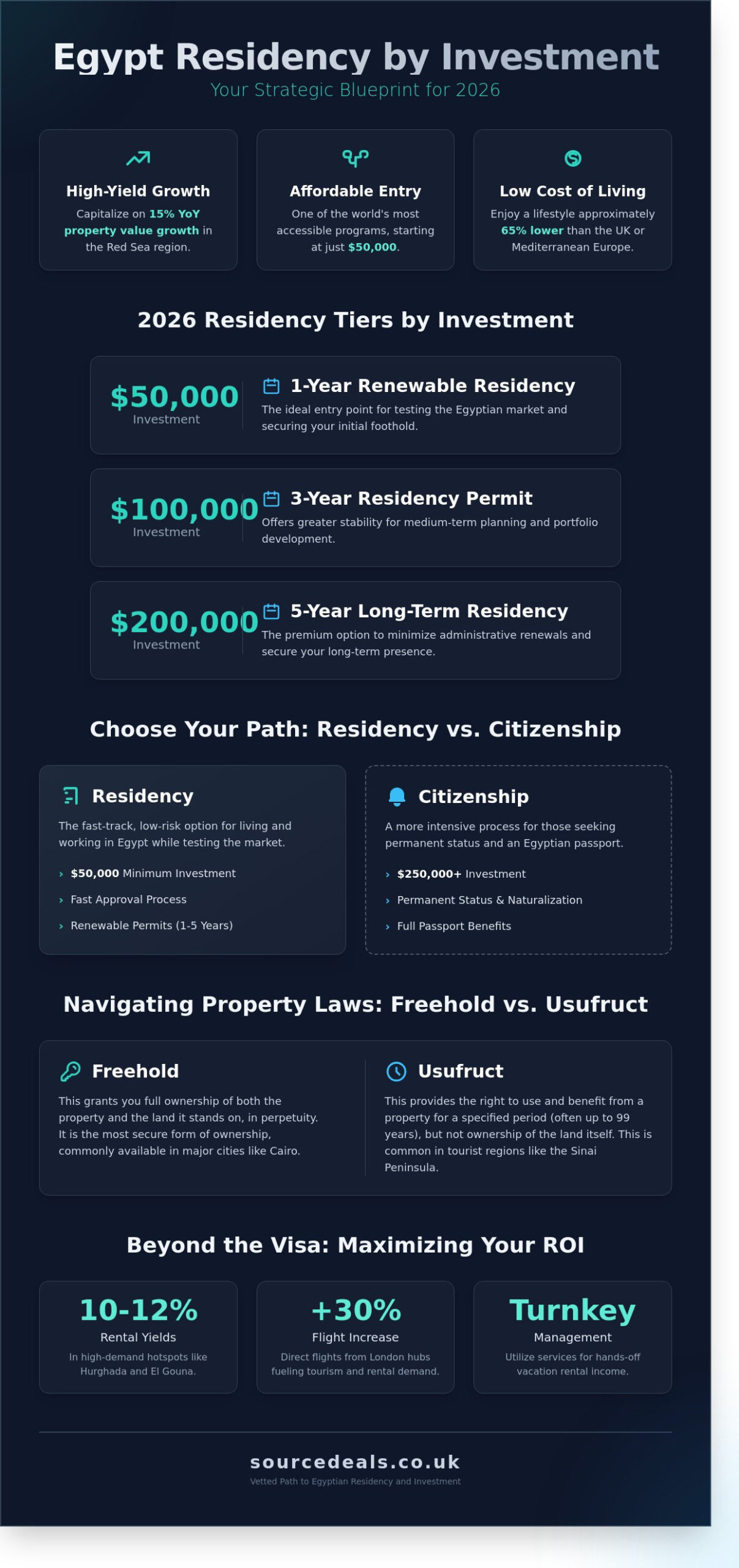
Egypt has emerged as the most accessible residency by investment market globally. Serious investors are moving capital here because the entry barrier remains remarkably low compared to the UAE or Southern Europe. Understanding how to get residency in egypt by buying property starts with recognizing the $50,000 entry point. This is a fraction of the cost required in Greece or Portugal. You get a strategic foothold in a country bridging Europe, Asia, and Africa. It’s a prime location for digital nomads and global business operators who need a central hub.
The 2026 property market is ripe for off-market sourcing, particularly in the Red Sea region. Tourism numbers hit record highs in 2025, pushing short term rental yields to 10% or 12% in hotspots like Hurghada and El Gouna. Finding these deals requires an insider edge. You want vetted, off-market units that aren’t inflated by retail agents. Secure these assets now to capitalize on the booming tourism sector and massive infrastructure spending scheduled for the next decade.
Lifestyle and Economic Benefits
Egypt offers a cost of living that’s approximately 65% lower than the UK or Mediterranean Europe. Your capital goes further here. Air connectivity is expanding at a rapid pace. In 2026, direct flights from London hubs to Hurghada and Cairo increased by 30% to meet investor demand. Foreign residents benefit from specific tax advantages under current 2026 regulations, including favorable treatment of overseas income. It’s a high-yield, low-tax environment designed for those who value efficiency and ROI.
Residency vs. Citizenship: Choosing Your Path
Investors often confuse these two distinct paths. Residency is the fast track. It requires just $50,000 in property value to secure a permit. This gives you immediate stability without a massive capital lockup. Citizenship is a more intensive process. While Egyptian nationality law provides a clear route to full naturalization, it demands a $250,000 non-refundable contribution or a $300,000 real estate investment.
- Residency: $50,000 minimum. Fast approval. Renewable permits.
- Citizenship: $250,000+ minimum. Permanent status. Passport benefits.
Most savvy investors choose residency first. It’s a low-risk way to test the market before committing to a larger portfolio. You get the legal right to live and work in the country while keeping your liquid assets available for other BMV opportunities. If you’re wondering how to get residency in egypt by buying property without overextending your budget, the $50k residency permit is the most logical starting point for 2026.
Understanding the 2026 Residency Tiers by Investment
Egypt’s updated 2026 investment framework offers a clear, structured path for international buyers. The process is strictly tiered. Your capital outlay directly dictates your stay duration. You must transfer all funds in foreign currency, typically USD or GBP, through a registered Egyptian bank. This is non-negotiable. It’s the primary mechanism the government uses to track your economic contribution. Understanding how to get residency in egypt by buying property requires a firm grasp of these three distinct levels.
- The $50,000 Tier: This entry-level bracket grants a 1-year renewable residency permit. It’s a low-barrier option for those testing the Egyptian market.
- The $100,000 Tier: Stepping up to $100,000 secures a 3-year residency permit. This provides significantly more stability for long-term portfolio planning.
- The $200,000 Tier: This is the premium residency option. It offers a 5-year long-term residency permit. Investors learning how to get residency in egypt by buying property often target this tier to minimize administrative renewals.
Investors looking for a more permanent solution might also explore Egypt’s official citizenship by investment program, which offers a direct pathway to a passport for those meeting higher financial benchmarks. For most, however, the residency tiers provide the necessary flexibility to manage local assets without the commitment of full citizenship.
Minimum Investment Thresholds
The Egyptian government doesn’t rely solely on your sales contract to verify value. They calculate property worth based on the actual amount of foreign currency transferred into the country. You need the “Green Contract” for absolute legal security. This official registration ensures your title is undisputed and recognized by the Ministry of Interior. You can include your spouse and children under 21 in your application at no additional investment cost. Finding vetted property deals that hit these specific price points is the first step toward a successful application.
Financial Compliance and Currency Rules
Compliance is the backbone of the 2026 residency program. You must document your source of funds to satisfy Egyptian anti-money laundering laws updated in late 2024. Your bank transfer receipts are your most vital assets. They carry more weight than the sales contract during the visa review process. Be mindful of exchange rate volatility. The government uses the official Central Bank of Egypt rate on the day of the transfer. Always transfer a slight surplus to ensure you don’t fall below the USD threshold if the EGP shifts during the registration window. This precision prevents delays in your permit issuance.
Freehold vs. Usufruct: Navigating Egypt’s Property Laws
Understanding the legal structure is vital if you want to know how to get residency in egypt by buying property. You’ll encounter two primary frameworks: Freehold and Usufruct. Freehold offers absolute ownership of the land and the building. It’s the gold standard for serious investors in 2026. Usufruct, or leasehold, grants rights for up to 99 years. While the timeframe is long, it’s a right of use, not total ownership. In the Sinai Peninsula, including Sharm El Sheikh, Usufruct is the only legal option for foreigners due to national security regulations. Smart capital is currently flowing toward freehold zones like Hurghada and Cairo to maximize long-term asset security.
The Egypt Investment Climate Statement highlights that while the government encourages foreign direct investment, property registration remains a complex hurdle. Investors must verify the “Green Contract” or administrative registration to avoid capital loss. Buying without verifying the land’s registration status is the fastest way to lose your deposit. In 2026, the market has no room for amateurs who skip this step. You need a verified paper trail before any funds move.
- Freehold: Full title deed, transferable, and inheritable. Best for capital appreciation.
- Usufruct: 99-year limit, restricted mainly to the Sinai region.
- Registration: Always demand the “Green Contract” to ensure the property is legally recognized by the state.
Where Foreigners Can Truly Own Land
If you’re researching how to get residency in egypt by buying property, you must target specific zones. Hurghada, Sahl Hasheesh, and New Cairo are the primary hubs for full freehold title. You cannot own agricultural land or property near historic sites like the Giza Plateau. Under Law No. 230 of 1996, which remains the benchmark in 2026, foreign individuals are limited to two properties for personal residence. Each must not exceed 4,000 square meters. If your goal is a high-yield portfolio, you’ll need to structure your acquisitions through a local company to bypass these personal limits.
Legal Due Diligence and the Power Team
Don’t cut corners on your legal team. A vetted local lawyer must perform a deep dive into the “chain of title.” They ensure every previous owner paid their taxes and that the developer actually owns the land they’re building on. Off-market deals often hide “clean” titles that haven’t been picked over by the masses. This is where a professional property sourcer becomes your greatest asset. They filter out the noise and present only verified, compliant opportunities. Success depends on building your property investment team with specialists who understand the 2026 regulatory environment. Your team is your shield against fraud and administrative delays.
The 5-Step Process to Securing Your Property and Residency
Investing in Egyptian real estate isn’t just about the brick and mortar; it’s a strategic move to secure legal status in a high-growth market. Understanding how to get residency in Egypt by buying property requires a disciplined approach to both the legal and financial frameworks. Follow this precise 5-step workflow to ensure your capital is protected and your residency is granted without unnecessary delays.
Don’t settle for retail listings. Target high-yield assets in the New Administrative Capital or the North Coast. Ensure the developer is vetted and the project has a proven track record. You’re looking for a turnkey asset that satisfies the government’s minimum investment threshold for residency, which remains pegged at $300,000 for the five-year permit in 2026.
Step 2: Execution of the Sales Contract and Initial Deposit.
Once you’ve identified a BMV (Below Market Value) opportunity, sign the preliminary sales contract. You’ll typically pay a 10% to 15% deposit to lock in the price. Ensure the contract explicitly mentions the intent for residency to align with local regulations.
Step 3: Foreign Currency Transfer and Bank Certification.
This is the most critical stage. You must transfer the funds from outside Egypt in foreign currency to a local Egyptian bank. The bank will issue a formal certification proving the funds arrived from abroad. This document is the backbone of your residency file.
Step 4: Registration with the Real Estate Registry ( الشهر العقاري ).
Register the contract at the local Real Estate Registry, known as Al Shahr Al Aqari. This provides the state-backed legal title required for residency. In 2026, many of these offices have moved to digital-first systems, significantly cutting down the manual paperwork that used to plague the process.
Step 5: Residency Application Submission.
Submit your completed dossier at the Passport and Immigration Office in Abbasiya. If your documentation is compliant, you’ll receive a temporary permit followed by your long-term residency card.
Step-by-Step Acquisition Workflow
Expect the entire cycle to take 3 to 6 months. The “Security Clearance” phase for foreign buyers is the primary variable; it’s a mandatory background check that takes roughly 60 days. You’ll need your original passport, certified bank statements showing the international transfer, and notarized contracts. Understanding how to get residency in Egypt by buying property means preparing for these timelines well in advance to avoid gaps in your legal stay.
Practical Tips for a Smooth Application
Efficiency is everything. Use a specialized agency to handle the residency filing. They have the local connections to bypass bureaucratic bottlenecks. Remember that residency requires periodic renewals, typically every 1 to 5 years depending on your investment tier. Integrating this into your broader International real estate investment strategy ensures long-term portfolio stability and maximum ROI.
If you’re ready to scale your portfolio with high-yield Egyptian assets, it’s time to act. Find exclusive off-market property deals today and secure your future in the MENA region.
Beyond the Visa: Maximizing ROI on Your Egyptian Investment
Securing legal status is just the first step. Smart investors look past the paperwork to the profit. While you’re learning how to get residency in egypt by buying property, you must also prioritize the underlying asset’s ability to generate cash flow. Egypt’s Red Sea coast, specifically Hurghada, remains a global hotspot for high-yield returns in 2026. Off-market deals are the gold standard here. They allow you to enter at prices 15% to 20% below market value (BMV), instantly boosting your equity from day one.
Your exit strategy should be as clear as your entry. The resale market in 2026 is liquid, driven by a growing class of European retirees and digital nomads. Prime coastal properties in gated communities have seen a 22% price increase over the last 24 months. If you buy right, your residency property isn’t just a visa tool; it’s a high-performing capital asset. Selling in the future becomes a simple matter of timing the market to capture maximum appreciation.
Generating Passive Income in Hurghada
In 2026, 1-bedroom apartments in prime areas like Sahl Hasheesh are delivering net rental yields between 9% and 12%. 2-bedroom units follow closely at 7.5% to 10%. These aren’t just theoretical numbers; they’re backed by year-round tourism and a 30% increase in international flights to Hurghada Airport since 2024. You don’t need to be on the ground to collect. Use vacation rental management in Hurghada to automate everything. Professional teams handle guest vetting, 24/7 maintenance, and dynamic pricing, ensuring your asset stays profitable while you’re anywhere else in the world.
Portfolio Diversification and Scaling
Your Egyptian asset shouldn’t stand alone. It’s a strategic anchor for a broader global portfolio. By leveraging the low entry costs and high ROI of the Egyptian market, you free up capital for acquisitions in more mature, lower-yield markets. This is the fastest way to master scaling a property portfolio with professional management. The goal is a balanced mix of high-growth emerging markets and stable, long-term holds. Egypt provides the cash flow necessary to fuel that expansion.
Ready to secure your future in the sun and build a high-yield portfolio? Don’t settle for over-priced public listings. Book a discovery call with our Egypt property experts today to access exclusive off-market deals that meet all residency requirements while maximizing your ROI.
Capitalize on Egypt’s 2026 Residency and Property Growth
The 2026 Egyptian property landscape presents a calculated opportunity for investors to secure a strategic foothold while locking in residency. You’ve learned that how to get residency in egypt by buying property depends on navigating specific investment tiers, ranging from the $50,000 entry point for a one-year visa to the $300,000 threshold for permanent options. Success requires a firm grasp of the legal shift toward freehold titles and the 8% to 12% yield potential found in prime Hurghada developments.
Don’t let complex regulations or opaque markets stall your portfolio expansion. Sourcedeals provides the professional edge required to execute these transactions with precision. We offer vetted off-market deals in Hurghada; these include professional management and transparent ROI reporting that tracks every penny of your 2026 earnings. Our experts provide grounded guidance on the latest property laws to ensure your investment is 100% compliant and secure.
Secure your high-yield Egyptian property and residency today with Sourcedeals
It’s time to turn these insights into tangible assets and secure your place in one of the region’s most promising markets.
Frequently Asked Questions
What is the minimum amount for residency in Egypt by property investment?
You need a minimum investment of $50,000 to secure a one year renewable residency permit in 2026. Higher tiers offer more stability; a $100,000 investment nets you a three year permit, while $200,000 grants a five year stay. These funds must be transferred from abroad through an Egyptian state bank to be valid. This remains the most direct path for those researching how to get residency in Egypt by buying property.
Can I get permanent residency in Egypt by buying a house?
Property investment provides renewable temporary residency rather than immediate permanent status. You can renew a five year permit indefinitely as long as you maintain ownership of the $200,000 asset. To qualify for a permanent Special Residence permit, you typically need 10 years of continuous legal stay in the country. It’s a long term play for serious investors seeking a strategic foothold in North Africa’s most active market.
Do I need to live in Egypt to maintain my residency permit?
You don’t need to reside in Egypt 365 days a year to keep your permit active. Most property based visas require you to enter the country at least once every six months to prevent the permit from lapsing. This flexibility allows you to manage your global portfolio while maintaining your residency status. It’s a low maintenance solution for high net worth individuals who value mobility and global access.
Can foreigners buy land in Egypt in 2026?
Foreigners can legally purchase up to two pieces of land for residential purposes, provided the total area doesn’t exceed 4,000 square meters. Under Law No. 230 of 1996, you’re required to build on the land within five years of the registration date. This prevents land banking and ensures active development in key zones. It’s a vetted process that requires specific approval from the Prime Minister’s office for certain restricted areas.
How long does the Egyptian residency application take after buying property?
The residency application process typically takes between 90 and 120 days after you’ve finalized the property deed. You’ll spend the first 30 days securing the Green Contract and necessary bank transfer certificates. Once submitted to the Passport, Emigration and Nationality Administration, the security clearance phase consumes the remaining 60 to 90 days. It’s a streamlined timeline compared to many European Golden Visa programs that now take over 12 months.
Can I rent out my property if I have a residency visa?
You’re fully permitted to rent out your investment property to generate a high ROI while holding your residency visa. Egypt’s rental market in 2026 offers yields between 6% and 9% in premium coastal developments like El Gouna or New Alamein. You’ll need to register your rental contract with the local tax authority and pay a flat 10% tax on the rental income. It’s a turnkey strategy for generating passive income from a vetted asset.
Is Egyptian citizenship included with property residency?
Residency doesn’t automatically grant citizenship, but a higher investment of $300,000 can fast track a passport application. Under the updated 2023 nationality laws, investors who purchase private or state owned assets worth $300,000 can apply for immediate citizenship. This path requires a $10,000 administrative fee paid to the government. Learning how to get residency in Egypt by buying property is often the first step toward this full legal and economic integration.
What are the taxes for foreign property owners in Egypt in 2026?
Foreign owners face a 2.5% real estate disposal tax when selling and a modest annual property tax. The annual tax is calculated as 10% of the property’s estimated rental value, minus a 30% deduction for maintenance costs. For a $200,000 apartment, this often equates to an annual bill of less than $400. It’s a highly tax efficient environment compared to the 20% to 40% rates commonly seen across Western Europe.