
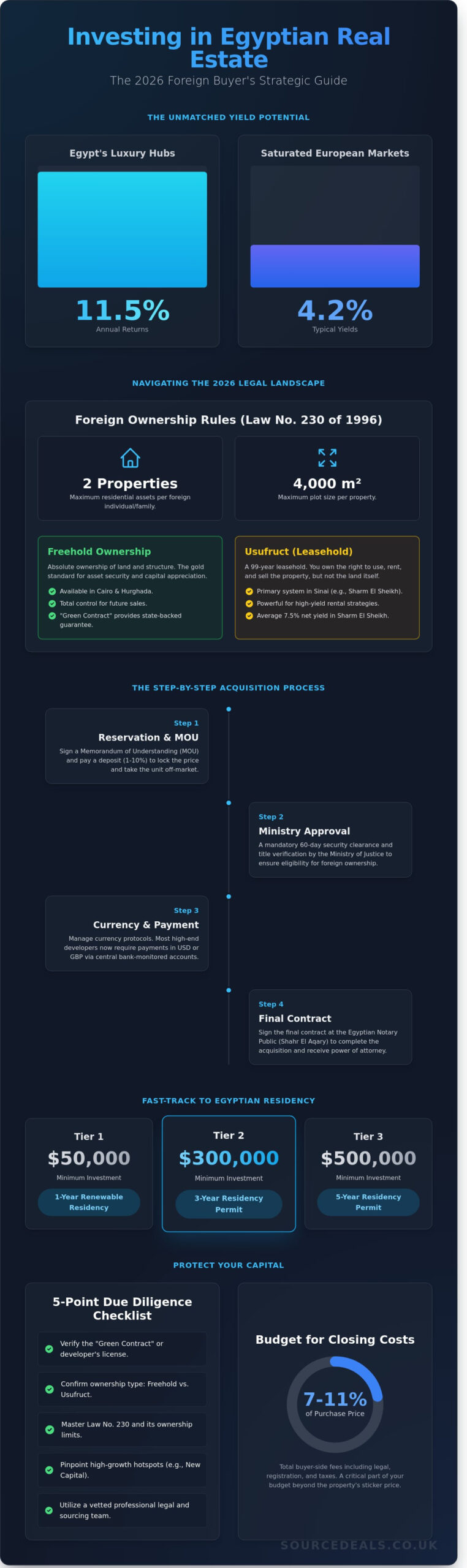
While most investors settle for 4.2% yields in saturated European markets, savvy capital is currently securing 11.5% annual returns in Egypt’s emerging luxury hubs. You’re likely aware that the best time to buy property in egypt for foreigners is during this current phase of massive infrastructure expansion, yet the fear of title disputes often stalls the most profitable moves. It’s a valid concern when entering international markets where transparency isn’t always the default. By late 2025, foreign direct investment in Egyptian real estate reached record levels, proving that the risk-to-reward ratio has shifted in favor of the bold.
This 2026 strategic guide ensures you secure your assets with professional precision. We’ll cut through the confusion surrounding Sinai usufruct laws versus Red Sea freehold titles to protect your capital from day one. You’ll master the legalities, identify the three specific hotspots outperforming the broader market, and discover the turnkey management solutions that deliver a truly hands-off 10%+ ROI. We’re moving past the fluff to give you the vetted data required to secure exclusive assets in the world’s most undervalued real estate frontier.
Key Takeaways
- Navigate the 2026 legal landscape by mastering Law No. 230 and the specific ownership limits currently imposed on foreign residential assets.
- Streamline your acquisition with a professional roadmap, moving from the initial MOU through to the critical Ministry of Justice approval phase.
- Pinpoint high-growth hotspots like the New Administrative Capital to maximize capital appreciation and secure elite rental yields.
- Protect your capital by applying a rigorous 5-point due diligence checklist designed to help you safely buy property in Egypt for foreigners.
- Transition from buyer to high-performing landlord by leveraging vetted sourcing professionals and professional, hands-off management systems.
The Legal Reality: Foreign Ownership Laws in Egypt 2026
Mastering the regulatory environment is the first step to secure a high-yield Egyptian portfolio. Law No. 230 of 1996 remains the primary legislation governing how you buy property in egypt for foreigners, but 2026 amendments have modernized the landscape. These updates prioritize digital registration and transparency to attract serious international capital. You’re legally permitted to own two residential properties in Egypt for your family’s use. Each plot must stay under the 4,000 square meter limit per property. These caps prevent market oversaturation and ensure land remains accessible to all buyers.
Your exit strategy depends entirely on the distinction between freehold and usufruct titles. Freehold grants you absolute ownership of the land and the structure. Usufruct is a long-term leasehold. Investors chasing maximum capital appreciation typically focus on freehold zones to ensure total control over the asset’s future sale. Don’t overlook the 2026 digital registry requirements; every transaction must now be logged through the national e-portal to be fully compliant with the latest anti-money laundering protocols.
Freehold Ownership in the Red Sea and Cairo
Cairo and Hurghada are the primary targets for investors seeking absolute security. These regions allow for full freehold title deeds, which are the most liquid assets in the Egyptian market. You’ll encounter two main paths for registration. The “Green Contract” is the government-verified gold standard. It provides a vetted, state-backed guarantee of ownership that prevents any future disputes. The alternative is the Court Validity Suite. This process is faster, often taking only 3 to 6 months, but it only confirms the signatures on your sales contract rather than the land’s history. Freehold ownership in Egypt represents the gold standard for asset security and undisputed title rights.
The Sinai Exception: Usufruct Rights in Sharm El Sheikh
Strategic security regulations mean foreigners can’t own land outright in the Sinai Peninsula. If you’re looking at Sharm El Sheikh, you’ll operate under the Usufruct system. This is a 99-year leasehold structure that grants you the right to use, rent, and sell the property. While you don’t own the dirt, you own the rights to the income it generates. For a 2026 investment strategy, Usufruct is a powerful tool for high-yield rentals. Current data shows Sharm El Sheikh maintains a 7.5% average net yield, often outperforming freehold areas in Cairo. It’s a viable play if your focus is ROI rather than generational land banking. Just ensure your legal team verifies the remaining term on the lease before you commit capital.
Step-by-Step Acquisition: The 2026 Buying Process
Speed and precision define the Egyptian market in 2026. To successfully buy property in egypt for foreigners, you must act with a clear roadmap. The process begins with a formal reservation. You’ll sign a Memorandum of Understanding (MOU) and pay a deposit, typically ranging from 1% to 10% of the purchase price. This document locks the price and removes the unit from the market. Don’t skip the due diligence phase here; your lawyer must verify the “Green Contract” or the developer’s license before funds move.
After the MOU, the file moves to the Ministry of Justice. This stage takes exactly 60 days for security clearance and title verification. It’s a mandatory cooling-off period where the government ensures the asset is eligible for foreign ownership. While this happens, you’ll manage currency protocols. Since the 2024 currency floatation, most high-end developers require payments in USD or GBP via central bank-monitored accounts. This protects your capital from local EGP volatility. Once cleared, you’ll attend the Egyptian Notary Public (Shahr El Aqary) to sign the final contract and receive your power of attorney.
Residency Visas and Property Purchase
Property investment is now the primary fast-track for Egyptian residency. In 2026, the government utilizes three distinct tiers to attract capital. A $50,000 investment secures a one-year renewable residency. Moving to the $300,000 tier grants you a three-year permit. For serious investors, a $500,000 purchase unlocks a five-year residency immediately. You must enter Egypt on a valid tourist visa to initiate these applications. If you’re looking for vetted investment opportunities that meet these specific visa thresholds, focusing on high-yield coastal regions is your best move.
Closing Costs and Hidden Fees
Budgeting for the sticker price alone is a rookie mistake. Total buyer-side closing costs in Egypt currently hover between 7% and 11%. You’ll face several specific charges:
- Maintenance Fund: A one-time fee of 8% to 10% of the property value, paid to the developer for upkeep.
- Legal Fees: Expect to pay 1% to 3% for a specialist solicitor. Cutting corners here is a false economy that risks your entire deposit.
- Real Estate Tax (Awaid): This is calculated as 10% of the annual rental value after a 30% deduction for maintenance expenses.
- Registration Fees: Fixed administrative costs at the Notary Public, usually capped at a few thousand EGP for residential units.
The 2026 market doesn’t reward hesitation. Secure your legal counsel early to ensure every document aligns with the latest Ministry of Justice mandates. When you buy property in egypt for foreigners, the winners are those who understand the timeline and have their foreign currency liquidity ready for immediate transfer.
Hotspots and Yields: Where to Buy in 2026
Success when you buy property in Egypt for foreigners depends on matching your exit strategy to the right geography. By 2026, the Egyptian market has split into three distinct performance zones. Each offers a unique balance of cash flow and equity growth. High-energy investors seeking immediate liquidity focus on the Red Sea. Those playing the long game for massive capital gains target the desert expansions of Cairo. You must decide if you want monthly bank deposits or a five year equity play.
- Hurghada: Delivers 8% to 12% gross rental yields via short-term holiday lets.
- New Administrative Capital (NAC): Projects 15% to 20% annual capital appreciation but faces a temporary rental supply overhang.
- North Coast (Sahel): Provides premium daily rates exceeding $500 in peak season, though the primary window is restricted to four months.
Hurghada: The Investor’s Safe Haven
Hurghada remains the most liquid market for international buyers. The city benefits from 365 days of sunshine and a constant influx of European tourists. This creates a resilient short-term rental market that functions independently of the local economy. For the highest ROI, target El Gouna for luxury premiums or Sahl Hasheesh for upscale resort living. The Intercontinental district offers the best entry prices for high-occupancy mid-range units. To maximize these returns, leverage our vacation rental management in Hurghada to ensure your asset remains a hands-off, turnkey income stream. Don’t leave your yield to chance; professional management is the difference between a 4% and a 10% return.
New Cairo and the New Capital
The New Administrative Capital is the engine of Egypt’s urban transformation. With over 50,000 government employees already relocated to the NAC by late 2025, the demand for high-quality housing is surging. Smart investors are securing off-plan units with Tier 1 developers like Emaar Misr and SODIC. These developers offer vetted, compliant contracts that protect your equity. While immediate rental demand is still catching up to the massive supply of new builds, the long-term capital gains are unmatched. You’re buying into the future financial hub of Africa. Focus on projects within the R3 and R7 residential districts. These areas capture the first wave of corporate tenants moving into the Central Business District. It’s a pure appreciation play that requires patience but offers the highest potential for a 2x or 3x return on your initial deposit.
The 2024 Ras El Hekma deal, worth $35 billion, has also turned the North Coast into a year-round prospect. However, for most who buy property in Egypt for foreigners, the Red Sea remains the king of consistency. Choose your zone based on your appetite for risk and your need for immediate cash flow.
Avoiding the “Tourist Trap”: Due Diligence and Power Teams
Egyptian real estate isn’t a playground for amateurs. If you want to buy property in egypt for foreigners without losing your capital, you must distinguish between street brokers and vetted professionals. Street brokers often operate via unregulated Facebook groups or local cafes; they lack professional indemnity and compliance. In contrast, a professional sourcing partner provides transparency and exclusive access to off-market deals. Smart investors who buy property in egypt for foreigners focus on the numbers and legal security, not just the Mediterranean view.
Professional Sourcing vs. DIY Searching
Unverified Facebook groups are a minefield for the unwary. Data from 2024 indicates that 15% of DIY international deals encounter significant title disputes or undisclosed liens. Professional sourcing identifies BMV (Below Market Value) opportunities that never reach public portals. This approach aligns with our broader international real estate investment strategy, focusing on high-yield assets that have already passed initial screening. You don’t want a holiday home; you want a high-performing asset.
The Role of the Specialist Conveyancer
Your lawyer must be independent of the developer or the seller. Never use the developer’s in-house legal team, as this creates a direct conflict of interest. A vetted lawyer is the only shield against title fraud. They ensure the Power of Attorney (Tawkeel) is specific and limited strictly to the purchase of the identified unit. This prevents unauthorized sales or encumbrances on your behalf. In the Egyptian market, a broad Power of Attorney is a massive liability that seasoned investors avoid at all costs.
A “Negative Certificate” is a non-negotiable component of your due diligence. This document, issued by the Real Estate Registry, confirms the property isn’t used as collateral for a bank loan. Without this, you could inherit the seller’s debt. Your power team needs to understand both UK investment standards and Egyptian administrative law to navigate these hurdles effectively.
Use this 5-point due diligence checklist for every Egyptian deal:
- Verify the Negative Certificate: Ensure the property is free of debt, mortgages, or legal liens.
- Chain of Title: Trace ownership back to the original government allocation or the first registered deed.
- Building License Verification: Confirm the structure is legal and matches 2026 urban planning regulations.
- Utility Clearance: Confirm no outstanding electricity or water bills from the previous 5 years.
- Developer Track Record: Analyze their last 3 completed projects for delivery delays or construction quality issues.
Building a power team that understands the local landscape while adhering to UK-level professionalism is the difference between a high-yield success and a costly mistake. Don’t settle for unverified leads when you can access professional-grade opportunities.
Secure your next high-yield opportunity by browsing our vetted property deals today.
Maximizing ROI: Management and Scaling with Sourcedeals
Acquiring the asset is only the first step toward wealth creation. To truly capitalize when you buy property in egypt for foreigners, you must bridge the gap between a signed contract and a high-yielding rental machine. Remote management remains the primary barrier for international investors. Sourcedeals eliminates this friction by providing a turnkey operational framework designed to hit 15% net ROI targets consistently. We don’t just find deals; we engineer the entire lifecycle of your investment.
Scaling a portfolio in a foreign market requires precision. Moving from a single apartment in El Gouna to a diversified collection of assets across Cairo and the Red Sea demands local expertise and vetted boots on the ground. Our team handles the heavy lifting, from tenant vetting to maintenance, ensuring your capital works as hard as possible without demanding your time. When it’s time to exit, we leverage our global network of ready buyers to ensure liquidity, whether you are selling to a local professional or an international fund looking for verified yields.
Remote Vacation Rental Management
Our approach to Hurghada holiday lets is built on total automation for the owner. We utilize data-driven pricing algorithms that adjust rates in real-time based on local demand, seasonal surges, and competitor occupancy. This strategy allows our clients to outperform the local market average by 22% in gross revenue. Every unit is managed by professional on-site teams who handle check-ins and cleaning 24/7. For investors looking to benchmark these returns, you can explore our Dubai property investment guide for a direct regional comparison on yields and management costs.
Success Fees and Portfolio Growth
We align our success directly with your bank balance. Our sourcing fee structure is performance-based; we only profit when we secure a deal that meets your specific financial criteria. This creates a transparent partnership where our primary goal is your capital growth. By working with Sourcedeals, you gain access to exclusive, vetted opportunities that never reach public portals like Property Finder. We filter out the noise, presenting only the top 5% of off-market inventory that passes our rigorous 20-point compliance check. This ensures that every time you buy property in egypt for foreigners through our platform, you’re entering the market with a built-in equity cushion.
The 2026 Egyptian market is moving fast. Don’t let high-yield opportunities slip away while you navigate the bureaucracy alone. Ready to secure your Egyptian asset? Contact Sourcedeals for expert sourcing today.
Secure Your 2026 Egyptian Portfolio Growth
Egypt’s real estate market is entering a pivotal phase in 2026, with the New Administrative Capital and Hurghada coastal developments driving unprecedented demand. You’ve analyzed the legal frameworks and identified the high-yield hotspots where double-digit rental returns are now the standard. Success in this territory requires more than just capital; it demands a strategic power team that eliminates the tourist trap risk. Don’t leave your capital appreciation to chance when you decide to buy property in egypt for foreigners. Sourcedeals brings compliance-focused UK sourcing standards to the Egyptian market, ensuring every opportunity meets our strict professional rigor. We grant you exclusive access to vetted off-market Egypt deals that bypass the inflated prices of public listings. Our expert Hurghada rental management team handles the ground-level operations, turning your acquisition into a truly passive, high-performance asset. The window for maximum entry-point advantage is narrowing as 2026 approaches. Take the lead by partnering with a team that prioritizes your ROI and security above all else.
Secure Your High-Yield Egyptian Investment Deal with Sourcedeals
Your path to a diversified, high-yield international portfolio starts with a single calculated move today.
Frequently Asked Questions
Can a foreigner own 100% of a property in Egypt?
Yes, foreigners can own 100% of up to two residential properties in Egypt under Law No. 230 of 1996. Each plot must stay under 4,000 square meters and be used for private residence rather than commercial trade. You’ll need a valid passport and a professional legal review to register the title at the local Shahr El Aqari office. This process secures your asset and ensures your investment is fully protected by Egyptian civil law.
Do I get residency if I buy property in Egypt in 2026?
You qualify for residency by purchasing property, with tiers starting at $50,000 for a one year renewable permit. Investing $100,000 grants a three year residency, while $200,000 secures a five year permit. These regulations, updated in early 2024, require the funds to be transferred from abroad through an Egyptian state bank. It’s a direct path to securing your base in a high growth market while enjoying long term stability.
Is it better to buy property in Cairo or Hurghada for investment?
Cairo offers 15% to 20% annual capital appreciation in New Cairo and the Administrative Capital, while Hurghada delivers 8% to 12% rental yields. Choose Cairo for long term equity growth and commercial demand. Pick Hurghada if you want a turnkey vacation rental with high occupancy rates from European tourists. Both locations are prime spots to buy property in Egypt for foreigners seeking diversified portfolios with high ROI potential.
What are the restrictions on foreigners buying land in Sinai?
Foreigners cannot own freehold land in the Sinai Peninsula, including Sharm El Sheikh, due to Decree No. 14 of 2012. You can instead secure a 99 year usufruct right, which allows you to use, lease, and sell the property’s benefits. This right is renewable and remains a standard practice for international investors in the Red Sea region. Always verify the developer’s military intelligence clearance before signing any contracts to ensure full compliance.
Can I rent out my Egyptian property on Airbnb legally?
You can legally rent your property on Airbnb if you obtain a license from the Ministry of Tourism under Law No. 8 of 2022. Short term rentals in gated communities often require additional approval from the homeowners’ association. Ensure you pay the 10% to 15% tax on rental income to stay compliant with local authorities. Professional property management companies in Egypt now handle these filings to maximize your occupancy and net profits.
What happens to my property if the Egyptian Pound (EGP) devalues?
Egyptian real estate acts as a hard asset hedge against currency fluctuations, with property values often rising faster than the devaluation rate. During the 40% EGP devaluation in early 2024, secondary market prices in prime areas spiked by 60% in local terms. Since most high end developers peg their pricing to construction costs influenced by the US Dollar, your asset’s value remains protected in international terms. It’s a proven wealth preservation strategy.
How much are the ongoing maintenance and tax costs for a foreign owner?
Annual property tax is approximately 0.1% of the unit’s market value after an initial exemption for primary residences worth under 2 million EGP. Expect to pay a one time maintenance fee of 5% to 10% of the purchase price into a sinking fund upon delivery. Monthly service charges for security and landscaping usually range from $50 to $150. These low carrying costs significantly boost your net rental yield compared to European markets.
Do I need an Egyptian bank account to buy property as a foreigner?
You don’t need a local bank account to buy property in Egypt for foreigners as you can wire funds directly to developers from overseas. However, opening an account at a bank like CIB or Banque Misr is essential if you’re applying for property based residency. It also simplifies paying recurring utility bills and receiving rental income from tenants. Most banks require a registered sales contract and a valid passport to open an account quickly.