
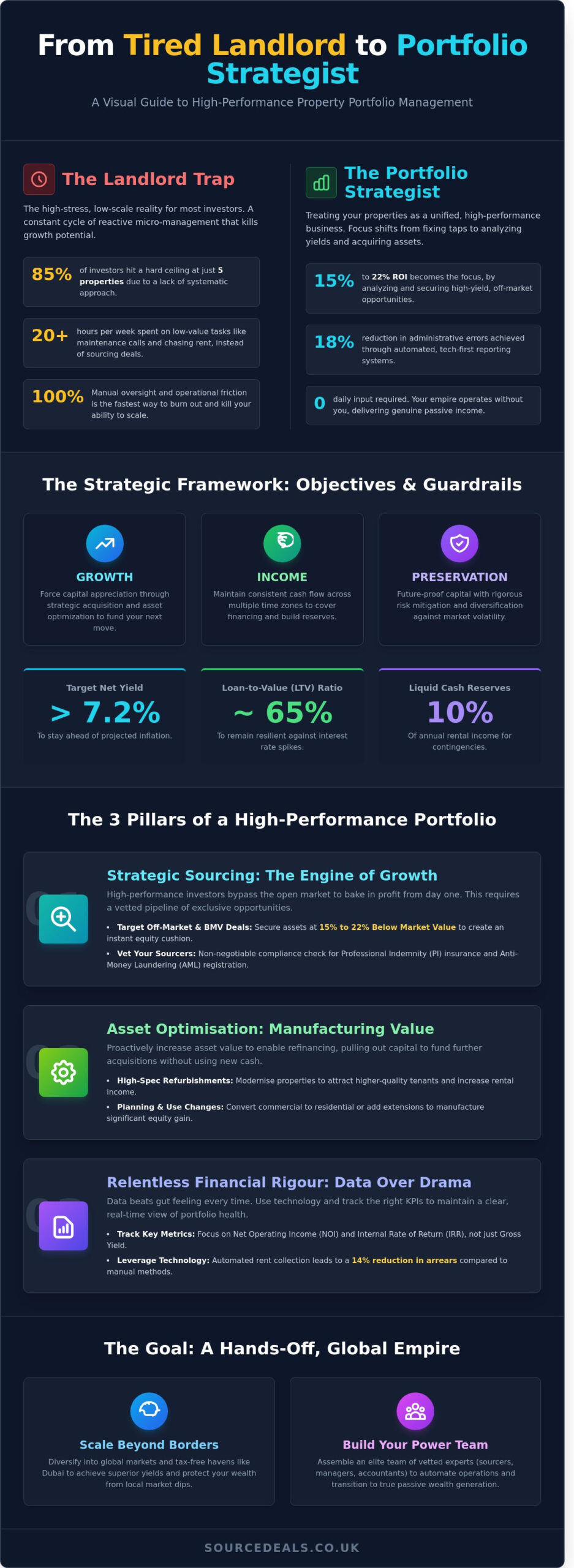
Owning ten properties doesn’t make you a mogul; it makes you a tired landlord with a high-stress side hustle. Data shows that 85% of investors hit a hard ceiling at 5 units because they lack a systematic approach to property portfolio management. If you’re spending 20 hours a week on maintenance calls instead of analyzing 15% ROI off-market deals, your strategy is broken. You already know that manual oversight is the fastest way to kill your scale. It’s time to stop trading your time for rent and start building a verified, high-yield empire that operates without your daily input.
This guide will show you exactly how to transition into a hands-off, international powerhouse by January 2026. You’ll learn the professional strategies used to secure vetted BMV opportunities and maintain consistent cash flow across multiple time zones. We’ll break down the framework for diversifying into global markets while securing your 8% to 12% target yields. We’re moving from chaotic ownership to a streamlined, turnkey system that delivers genuine passive income.
Key Takeaways
- Shift from landlord to strategist by mastering professional property portfolio management to maximize ROI across your entire asset base.
- Secure high-yield, off-market BMV deals and leverage asset optimization techniques to force capital appreciation and enhance portfolio value.
- Future-proof your capital by navigating the 2026 compliance landscape and implementing rigorous risk mitigation protocols for international assets.
- Scale your wealth beyond borders into tax-free havens like Dubai to achieve superior yields and global diversification.
- Build an elite power team of vetted experts to automate your operations and transition from active management to passive wealth.
What is Property Portfolio Management and Why Does it Matter?
Property portfolio management is the strategic oversight of multiple real estate assets to maximize total ROI. It’s more than just collecting rent. In 2026, the market demands that you treat your holdings as a unified business entity. This approach ensures every pound of equity works toward a specific financial goal. You don’t want to be a hobbyist landlord; you want to be a professional asset manager. It is the difference between owning a job and owning a wealth-generating machine.
Investors often fall into the “Landlord Trap.” They spend 15 hours a month on operational friction like coordinating repairs or chasing late payments. This micro-management kills your ability to scale. Professional property portfolio management shifts your focus from fixing taps to analyzing yields. By 2026, top-tier investors will use tech-first systems for remote rent collection and real-time reporting. Data shows that automated reporting reduces administrative errors by 18%, letting you focus on high-level acquisitions instead of paperwork.
The Portfolio Mindset vs. Single Asset Ownership
Stop obsessing over individual property fluctuations. You must focus on aggregate yield across your entire board. If one unit in Manchester faces a temporary vacancy, your high-performing assets in Birmingham or Liverpool carry the weight. Use turnkey solutions to outsource the daily grind. This strategy frees your schedule to hunt for exclusive off-market deals that others miss. Property portfolio management serves as a high-performance vehicle for building and protecting multi-generational wealth.
Key Objectives: Growth, Income, and Preservation
A robust 2026 strategy balances capital appreciation with monthly cash flow. You need income to cover financing, but you need equity growth to fund your next move. Diversification is your best defense against UK market volatility. Spreading risk across different postcodes prevents a local economic dip from hurting your total returns. Set these specific benchmarks for your property portfolio management strategy:
- Target Net Yield: Aim for a minimum of 7.2% to stay ahead of projected inflation.
- LTV Ratios: Keep a 65% Loan-to-Value ratio to remain resilient against interest rate spikes.
- Cash Reserves: Maintain 10% of annual rental income as a liquid contingency fund for rapid repairs.
By establishing these financial guardrails, you move from reactive management to proactive growth. You aren’t just surviving the market; you’re dominating it.
The Three Pillars of a High-Performance Property Strategy
Effective property portfolio management transforms a random assortment of buy-to-lets into a scalable wealth engine. You aren’t just collecting houses; you’re building a business. This requires three core disciplines: strategic sourcing, asset optimisation, and relentless financial rigour. Without these, your growth will stall as soon as the market shifts.
Sourcing: The Engine of Portfolio Growth
Off-market deals are the lifeblood of immediate equity. Buying through traditional portals often means paying a premium. By the time a property hits the open market, the profit margin has already shrunk due to competition. High-performance investors target Below Market Value (BMV) entry points to bake in profit on day one.
Compliance is non-negotiable. You must vet your sourcers for Professional Indemnity insurance and Anti-Money Laundering (AML) registration. Angel Dragons Ltd identifies high-yield opportunities before they reach the public, ensuring 15% to 22% BMV margins. If you want to scale fast, you need a pipeline of vetted off-market property deals that bypass the bidding wars and provide instant capital cushions.
Performance Metrics You Must Track
Data beats gut feeling every time. To maintain a healthy Loan-to-Value (LTV) ratio, typically capped at 75% for 2026 lending cycles, you need to track specific KPIs. Don’t confuse Gross Yield with Net Yield. While a 9% Gross Yield looks good on paper, your Net Operating Income (NOI) tells the real story after management fees, insurance, and maintenance costs are deducted.
- Internal Rate of Return (IRR): This accounts for the time value of money, providing a clearer picture of long-term profitability than simple ROI.
- Net Operating Income (NOI): This is your total income minus all necessary operating expenses. It’s the pulse of your property portfolio management.
- Remote Rent Collection: Use automated tools to ensure 100% payment transparency. In Q1 2026, tech-enabled landlords reported a 14% reduction in arrears compared to manual tracking.
Asset optimisation is the final pillar. Whether it’s a change of use from commercial to residential or a high-spec refurbishment, you must manufacture value. This allows for refinancing to pull out capital for your next acquisition. By increasing the property’s value through planning gains or better layouts, you create a recycling model for your capital. This is how you build an empire rather than just a collection of assets.
Risk Mitigation and Strategic Asset Allocation
Effective property portfolio management in 2026 demands a ruthless approach to risk. Investors face a triple threat: physical depreciation, financial volatility, and shifting regulations. By January 2026, the UK’s Renters’ Rights Act has fundamentally altered eviction protocols; failing to adapt costs an average of £15,000 in legal fees and lost rent per instance. You must audit your assets against three specific pillars. Physical risks include the 2030 EPC “C” mandate, which requires immediate capital expenditure planning. Financial risks involve hedging against the 4.25% base rate fluctuations seen throughout late 2025. Regulatory risks center on the mandatory registration of all short-term lets.
Success hinges on two words: vetted and verified. Don’t touch a deal unless the sourcer is registered with the Property Redress Scheme and the asset has passed 25-point due diligence. This isn’t just bureaucracy; it’s your shield against the 12% rise in property fraud reported by the Land Registry last year. Only engage with verified off-market opportunities to ensure your ROI remains protected from public market bidding wars. High-yield outcomes are built on the back of rigorous, non-negotiable compliance checks.
Diversification: The Ultimate Risk Hedge
Never lock your capital into a single postcode. Spread your holdings across high-growth hubs like Manchester and Birmingham to capture 6% yields while maintaining a presence in stable London zones. Balance your strategy by mixing long-term residential leases with high-cash-flow vacation rentals. Smart investors in 2026 allocate across currency zones to neutralize inflation. Aim for a split: 50% GBP for domestic stability, 30% AED for tax-free growth in Dubai, and 20% EGP for high-upside emerging markets in New Cairo. This multi-currency approach secures your wealth against localized economic downturns and currency devaluations.
Compliance and Security in 2026
In the current market, compliance isn’t a hurdle; it’s your greatest competitive advantage. Every international transaction requires verified legal conveyancing and authenticated title deeds to prevent ownership disputes. In the UK, active membership in the Property Redress Scheme is the minimum standard for professional operations. Ensure your property portfolio management strategy includes quarterly audits of all safety certificates and insurance policies. Compliance is the foundation of scalable real estate because it transforms a volatile gamble into a predictable, institutional-grade asset class. Use these frameworks to build a portfolio that thrives under scrutiny and scales without friction.
Scaling Beyond Borders: International Portfolio Diversification
Domestic yields in the UK often hover between 4% and 6%. For aggressive growth in 2026, sophisticated property portfolio management requires a pivot toward international markets where double-digit returns are the standard. Diversifying across borders mitigates currency risk and taps into tax-efficient jurisdictions that outpace Western growth rates. Investors are moving capital into regions with massive infrastructure pipelines and favorable foreign ownership laws.
Dubai remains the primary target for high-growth capital. The city’s 2040 Urban Master Plan aims to increase the population to 5.8 million, creating a sustained demand for housing. You benefit from 0% tax on rental income and capital gains. Hurghada, Egypt, offers a different play. It’s a high-yield cash flow engine. With tourism numbers up 15% in 2024, short-term vacation rentals in gated communities deliver ROIs exceeding 12% annually. You aren’t just buying brick and mortar; you’re buying into global tourism demand.
Investing in Dubai and Hurghada
Dubai’s off-plan market is built for maximum equity gains. Investors typically see 20% to 30% capital appreciation between the initial deposit and project completion. In Hurghada, the focus shifts to the European holiday market. German and British tourists drive year-round occupancy. Use multi-currency digital accounts to collect rent in Euros or Dollars, bypassing local currency volatility and keeping your profits liquid and accessible.
Overcoming the Barriers to Overseas Investment
Distance is no longer a deal-breaker. Successful property portfolio management on a global scale relies on a “Power Team” of vetted local experts. You need boots on the ground to handle everything from snagging lists to tenant vetting. Navigating foreign laws requires precision:
- Indonesia: Use “Hak Pakai” titles for secure long-term residential rights in hotspots like Bali.
- Cyprus: Leverage permanent residency programs through property investment to gain an EU foothold.
- Tanzania: Focus on Zanzibar’s “Strategic Investment Projects” which offer 100% foreign ownership and significant tax holidays.
Don’t let language barriers or legal red tape stall your expansion. Partner with management firms that provide turnkey solutions, from legal due diligence to 24/7 maintenance. This ensures your international assets perform like a local investment without the need for a long-haul flight.
Ready to find your next high-yield international asset? Access vetted off-market deals now.
Building Your Power Team: The Path to Passive Wealth
Lone wolves don’t build empires in the UK housing market. Every top-tier investor relies on a network of specialists to maintain a competitive edge. Effective property portfolio management is less about doing the work yourself and more about orchestrating a high-performance team. You need vetted sourcers to find off-market gems, managers to protect your ROI, and legal experts to navigate the 2026 regulatory landscape. By integrating Sourcedeals tools, you gain a transparent, bird’s-eye view of your assets, ensuring no lead or maintenance issue slips through the cracks.
Selecting Your Sourcing and Management Partners
Don’t sign a sourcing agreement without scrutinizing the fee structure. Professional sourcers typically charge a success fee between 2% and 3% of the purchase price, rather than demanding heavy upfront retainers. This keeps their incentives aligned with your results. If you’re targeting high-yield holiday lets, specialized vacation rental management is non-negotiable. These experts often increase gross yields by 35% compared to standard long-term lets by optimizing seasonal pricing. To stay sharp, audit your management team’s performance every 90 days. Measure them against specific KPIs like a maximum 4% void rate and a 48-hour maintenance response time.
The Role of Mentorship in Scaling
A business coach is just as vital as a property manager when you’re looking to explode your numbers. Real estate coaching doesn’t just teach you about bricks and mortar; it compresses a five-year learning curve into 12 months of focused action. Scaling from 5 to 50 properties requires a total mindset shift. You’ve got to stop acting like a landlord and start thinking like a CEO. This means moving away from micro-managing individual tenancies and focusing on capital allocation and systemic growth. It’s the only way to achieve true passive wealth without burning out. Take control of your growth with Angel Dragons coaching and sourcing to ensure your property portfolio management strategy is built for the long haul.
Take Command of Your Scaling Strategy
Scaling your wealth doesn’t happen by accident. It requires a rigorous approach to property portfolio management that balances calculated risk with high-yield opportunities. By 2026, the gap between stagnant portfolios and high-performance ones will depend on strategic diversification across international borders. You’ve identified the three pillars of strategy, risk mitigation, and the power team necessary to turn active assets into passive wealth. Now, it’s time to execute.
Success in this market demands speed and access to non-public data. Sourcedeals.co.uk leverages over 5 years of international sourcing expertise to put you ahead of the competition. We deliver vetted and compliant off-market opportunities, providing comprehensive management from Hurghada to London. Our platform filters out the noise, leaving only the high-ROI deals that meet strict 2026 compliance standards. Stop wasting hours on traditional portals and start building your legacy with professional-grade tools.
Secure your next high-yield deal with Sourcedeals.co.uk
Your path to a global, recession-proof portfolio starts today.
Frequently Asked Questions
How many properties constitute a portfolio for management purposes?
A portfolio officially starts at 4 mortgaged properties according to most UK lenders like NatWest and Barclays. Once you reach this 4-property threshold, you’re classified as a portfolio landlord. This shift requires more rigorous stress testing and a comprehensive business plan to secure further financing for your expansion.
Is it better to manage my own properties or hire a professional?
Professional management is the superior choice once you own 5 or more units. While DIY management saves the 10% to 15% service fee, it consumes roughly 10 hours of admin per property each month. Outsourcing to experts ensures 100% compliance with the 168 separate laws affecting UK landlords, freeing your time for scaling.
What are the average fees for property portfolio management in the UK?
Average UK management fees range from 10% to 15% of the monthly rental income plus VAT. You’ll also encounter a setup fee, typically between £200 and £500, for each new tenancy. Full management covers everything from 24/7 maintenance to rent collection, ensuring your investment remains a passive income stream.
How do I manage a property portfolio in a different country like Egypt or Dubai?
Hire a RERA-certified agent in Dubai or a vetted local firm in Egypt to handle daily operations and local tax compliance. You must have a boots on the ground partner to navigate specific regional laws and currency fluctuations. Use a centralized digital dashboard to monitor your international ROI and maintenance schedules in real-time.
What is the difference between asset management and property management?
Asset management focuses on long-term ROI and capital growth through strategic refinancing and 5-year exit plans. Property management handles the tactical, daily tasks like fixing boilers and collecting monthly rent. One strategy builds your wealth through data-driven decisions; the other protects your assets through operational excellence and tenant retention.
How can I use technology to streamline my rent collection?
Deploy cloud-based platforms like Hammock or Re-Leased to automate your payment tracking and reduce late payments by 25%. These tools sync directly with your bank feed to provide instant notifications and digital audit trails. Effective property portfolio management relies on this automation to maintain a 98% collection rate across all units. However, tracking the right real estate portfolio metrics is crucial to ensure your technology investments actually improve your bottom line rather than just creating more data noise.
What is a below market value (BMV) deal and how do I find one?
A BMV deal is a property secured at 15% to 30% below its current RICS valuation. You won’t find these on public portals like Rightmove; they’re found through off-market sourcers or distressed sales. Using a professional sourcing platform gives you exclusive access to these high-margin opportunities before the general public sees them.
Do I need a specific type of mortgage for a multi-property portfolio?
You need a specialist portfolio mortgage or a limited company BTL mortgage once you exceed 4 properties. Lenders apply a global interest cover ratio of 145% across your entire holding to ensure the debt is sustainable. This specialized financing is a core component of property portfolio management, allowing you to scale efficiently under one legal entity.