
Egypt’s real estate sector contributed 20% to the nation’s GDP growth in 2025, yet the majority of international capital remains sidelined by old fears of informal contracts and currency swings. You’ve likely watched the 40% devaluation of the EGP in recent years and wondered if your capital would simply evaporate before you even receive the keys. It’s a valid concern for any serious investor looking at buying property in egypt as a foreigner 2026. You want high-yield assets, not a legal headache that ties up your liquidity for a decade.
We’ve done the heavy lifting to ensure your entry into this market is both secure and profitable. This guide provides a strategic blueprint to master the latest legal ownership laws, identifies the specific zones delivering 9% rental yields, and connects you with vetted partners who handle the ground-level management. We’re moving past the informal traps to focus on verified, high-performance assets. By the end of this briefing, you’ll have a shortlist of 2026’s most lucrative hotspots and a clear roadmap to scale your North African portfolio with total confidence.
Key Takeaways
- Capitalize on the post-2024 economic stabilization and leverage the New Administrative Capital’s growth to secure high-yield assets.
- Master the legal framework for buying property in egypt as a foreigner 2026, ensuring you navigate freehold and usufruct regulations with total compliance.
- Evaluate the ROI potential of Hurghada’s high-occupancy vacation rentals against the long-term capital appreciation of the New Administrative Capital.
- Implement a proven 5-step acquisition strategy to filter exclusive off-market opportunities and execute “boots on the ground” verification with precision.
- Bridge the gap between UK investment standards and Egyptian opportunities by utilizing professional, turnkey management solutions that protect your remote portfolio.
The 2026 Egyptian Real Estate Landscape: Why Now?
Timing defines the difference between a standard return and a portfolio-defining win. Secure your position now. Buying property in Egypt as a foreigner 2026 offers a rare window where post-reform stability meets early-stage capital appreciation. The market has moved past the volatility of the 2024 currency floatation. It’s now entering a phase of structured, sustainable growth. Investors using USD or GBP possess unprecedented purchasing power in a market that’s rapidly professionalizing.
The 2024 Ras El Hekma deal changed the game entirely. This $35 billion investment from the UAE didn’t just provide a liquidity cushion; it set a new floor for land valuations across the North Coast and Cairo. By 2026, the first phases of these mega-projects are hitting the secondary market. You aren’t buying into a hope anymore. You’re buying into a proven, multi-billion dollar development cycle. This Overview of the Egyptian housing market highlights how the shift from informal to regulated, high-end developments is creating a transparent environment for international capital.
Egypt’s New Administrative Capital (NAC) serves as the primary engine for this demand. By 2026, the transition of government ministries and foreign embassies is complete. This isn’t a ghost city. It’s a functioning hub of 6.5 million people. Demand for high-quality residential units and Grade-A office space is outstripping supply. This supply-demand imbalance is your primary driver for ROI. You’re entering the market at a sweet spot; the infrastructure is ready, but the prices haven’t yet reached the ceiling seen in mature regional hubs like Dubai.
For investors comparing emerging opportunities with established markets, the professionalism of agencies like Chainex Real Estate in Dubai offers a valuable benchmark for service and transparency.
Economic Reforms and Foreign Investment Incentives
Government policy now actively courts your capital. Recent amendments to Law No. 230 of 1996 have streamlined the path to residency through property ownership. If you invest $300,000 or more, you’re eligible for residency benefits that were previously bogged down in red tape. Inflation is cooling. Analysts project a drop to 10-12% by mid-2026, down from the 35% peaks of 2024. This stabilization makes EGP-denominated rental yields, often hitting 8-10% in prime areas, exceptionally attractive when converted back to harder currencies.
Infrastructure Growth as a Yield Driver
Connectivity dictates value. The Siemens-led high-speed rail project is now operational, linking the Red Sea to the Mediterranean at speeds of 250km/h. This reduces the travel time between Cairo and the North Coast to under two hours. Furthermore, the expansion of Sphinx International Airport and Hurghada’s new terminal has increased passenger capacity by 40% since 2023. These aren’t just transport links. They’re value multipliers for short-term holiday rentals.
Investors must understand the Infrastructure-Yield Correlation. In emerging markets, property values typically jump 15-20% in the 12 months following the completion of major transit hubs. Buying property in Egypt as a foreigner 2026 allows you to capture this final surge before the market fully matures. Don’t wait for the news to hit the mainstream portals. The smartest deals are secured while the paint is still wet on the new rail lines. Egypt is no longer a speculative play; it’s a strategic necessity for any serious global investor.
Legal Framework: Can a Foreigner Truly Own Property in Egypt?
Egypt’s legal landscape for international investors has shifted dramatically. Under Law No. 230 of 1996, updated for the 2026 market, foreigners hold clear rights to own residential assets. You’re limited to two properties across the country. Each unit cannot exceed 4,000 square meters. These rules prevent market monopolization while keeping the doors open for serious capital. You must also finalize construction within five years if you buy vacant land. This prevents speculative land banking and keeps the market moving at a healthy pace.
Ownership isn’t uniform. Most of Egypt offers “Freehold” title. This gives you absolute rights indefinitely. However, specific zones like the Sinai Peninsula operate under “Usufruct” agreements. These are 99-year leases. While secure, they don’t offer the same perpetual equity as freehold titles found in Cairo or the Red Sea coast. Distinguishing between these two is the first step in buying property in egypt as a foreigner 2026. If a deal looks too good to be true in Sharm El Sheikh, check the lease term immediately.
The 2026 Digital Registration Law solved the “Green Contract” bottleneck. Previously, manual registration could take years, leaving buyers in a legal limbo. Now, the government mandates electronic filing for all new transactions. This shift aligns with the U.S. State Department’s view on Egyptian real estate investment, which highlights the country’s efforts to strengthen property rights and transparency. Digital records are now the only legally recognized proof of ownership. This change has slashed the time required for title transfers from 18 months to under 30 days.
The New Digital Real Estate ID System
Every property now receives a unique digital code. Think of it as a National ID for your apartment. This 2026 database tracks every transaction history in real time. It makes double-selling impossible. If a seller can’t produce a valid digital ID, walk away. This system is the ultimate safeguard for your ROI. It ensures your title is vetted and compliant before you ever transfer funds. Digital registration is a non-negotiable requirement for any serious investor in the current market.
Taxes and Fees for Overseas Buyers
Budgeting requires precision. You’ll face a 2.5% real estate disposal tax. Legally, the seller pays this, but savvy buyers often see it factored into the final asking price. Annual property tax, known as Awaid, applies to residential units valued over 2 million EGP. Expect to pay between 3% and 5% of the total purchase price for legal fees and registration costs. Cutting corners here creates massive risk. If you want to secure off-market property deals that have already cleared these regulatory hurdles, use a verified partner. Buying property in egypt as a foreigner 2026 is lucrative, but only if you factor in these transaction costs from day one.
- Law 230 of 1996: The primary legislation governing foreign ownership.
- Two-Property Limit: Maximum units allowed per foreign individual.
- 4,000 SQM: The maximum size allowed for each residential unit.
- 5-Year Rule: Construction deadline for those purchasing land.
Investment Hotspots: Hurghada vs. New Administrative Capital
Investors entering the Egyptian market face two distinct paths. Hurghada represents the high-yield, short-term rental play. The New Administrative Capital (NAC) is the institutional, long-term growth play. Your choice dictates your 2026 tax strategy and cash flow profile. Success in this market isn’t about finding a property; it’s about matching the asset to your specific exit strategy.
Hurghada: Maximizing Vacation Rental ROI
Hurghada has evolved into a 365-day rental powerhouse. By 2026, net rental yields in premium zones like Magawish and Sahl Hasheesh have stabilized between 9% and 13%. European demand drives this growth. Data from early 2026 shows that over 70% of bookings in gated compounds originate from Germany, the UK, and Italy. Sourcedeals focuses on Hurghada because it offers the fastest path to liquid returns. It’s the primary cash-flow engine for international portfolios.
Investors must prioritize turnkey properties. In 2026, “off-plan” is for capital growth, but “ready-to-move” is for immediate income. Before signing any contracts, review the UK government guidance on buying property in Egypt to verify your solicitor’s due diligence process. We recommend vetted compounds that offer on-site management. This removes the logistical headache of cross-border landlording. Look for units with direct beach access or proximity to the Senzo Mall area to ensure occupancy rates stay above 80% during the shoulder seasons.
The New Administrative Capital: The Institutional Play
The NAC is no longer a blueprint. It’s a functioning metropolis. As of January 2026, 30 government ministries have fully relocated, bringing 50,000 employees into the city core every day. The Central Business District (CBD), anchored by the 393-meter Iconic Tower, is the primary target for commercial investment. This is where the big money is moving. It’s a play for stability and massive capital appreciation.
Commercial units in the NAC currently outperform residential ones in terms of lease stability. Expected capital appreciation for R3 residential units is 18% annually, but commercial spaces in the CBD offer 10-year lease guarantees with blue-chip tenants. Buying property in egypt as a foreigner 2026 requires a focus on these high-demand “Smart City” sectors. The infrastructure is world-class. It features AI-driven traffic management and a 100% fiber-optic network, making it the only choice for corporate-grade rentals.
Emerging Contenders: El Gouna and the North Coast
El Gouna remains the premium benchmark for luxury. It’s a closed-gate ecosystem where property values increased by 22% between 2024 and 2026. It targets the ultra-high-net-worth segment, offering scarcity value that Hurghada cannot match. If your goal is wealth preservation in a dollar-pegged environment, El Gouna is the answer.
The North Coast (Sahel) has also transformed. Once a two-month summer retreat, the Ras El Hekma development has turned it into a year-round destination. Foreign investment here surged after the $35 billion UAE deal in 2024. If you’re buying property in egypt as a foreigner 2026, don’t ignore the North Coast for luxury resale opportunities. It’s becoming the “Mediterranean Florida” of the Middle East. Focus on these four areas:
- Hurghada: Immediate cash flow and holiday rentals.
- NAC: Institutional growth and commercial leases.
- El Gouna: Premium wealth preservation.
- North Coast: High-end lifestyle and resale potential.
The 5-Step Sourcing and Acquisition Process
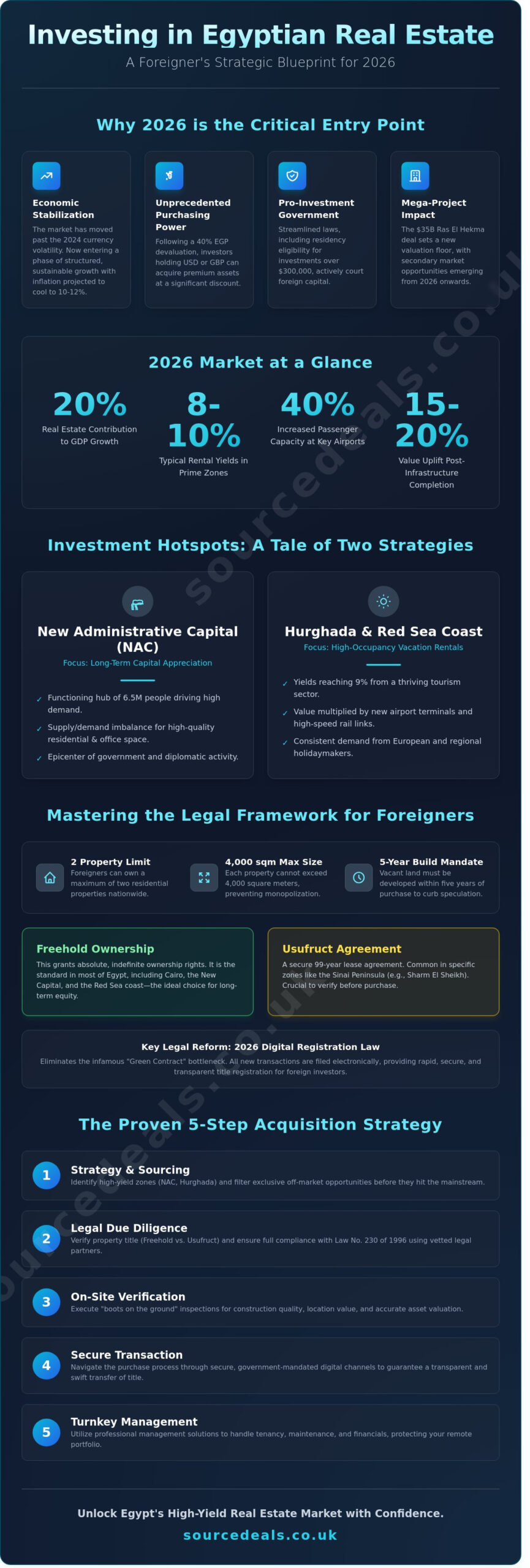
Securing high-yield assets in North Africa requires a clinical approach. You aren’t just buying a home; you’re acquiring a financial instrument. Success in buying property in Egypt as a foreigner 2026 hinges on moving from emotional browsing to data-backed execution. Follow this streamlined five-phase roadmap to lock in your next deal.
- Phase 1: Define Your Investment Criteria. Decide between yield and growth immediately. Investors targeting the New Administrative Capital (NAC) often see 8% to 11% gross rental yields. Those eyeing the North Coast or Red Sea focus on capital appreciation, which hit 35% in some districts during the 2025 fiscal year.
- Phase 2: Sourcing and Verification. Start with digital vetting, but never skip the physical inspection. Use a “Boots on the Ground” partner to verify that the construction progress matches the developer’s marketing brochures. In 2026, 15% of off-plan projects face delays; physical site visits mitigate this risk.
- Phase 3: Reservation and the Mahrany Check. Pay a 1% to 2% reservation fee to take the unit off the market. This triggers the “Mahrany” check, a deep-dive legal audit of the property’s history. You’re looking for a clean break from any previous encumbrances.
- Phase 4: Contracts and Payments. Sign the sales and purchase agreement (SPA). Off-plan contracts are standard for foreigners because they offer structured entry points. Resale deals require immediate capital but offer instant cash flow.
- Phase 5: Possession and Management. Once the keys are in hand, implement a professional management system. Don’t try to manage a Cairo apartment from London. Local property managers typically charge 10% of monthly rent but ensure 95% occupancy rates.
Due Diligence: Avoiding Common Pitfalls
Clean titles are the bedrock of Egyptian real estate. You must verify the “Sequence of Ownership” to confirm every transfer from the original government land allocation to the current seller is documented. Check for utility debt and maintenance fee clearances before you sign anything. Hiring an independent lawyer ensures your interests are the sole priority, whereas agency lawyers often prioritize closing the deal to secure their commission. This single move protects your capital from hidden liabilities.
Financing and Payment Plans
The 2026 market is dominated by developer-led financing. Most Tier-1 developers offer 0% interest payment plans spanning 5 to 8 years. These plans are the primary vehicle for buying property in Egypt as a foreigner 2026 because traditional mortgages remain difficult to access. Local bank rates for foreigners often hover around 20%, making them unviable for most. When transferring funds, use official banking channels to ensure you comply with Central Bank of Egypt regulations. This creates a transparent paper trail, which is essential if you decide to repatriate your profits later.
Stop wasting time on low-quality listings and start building your international portfolio today. Access vetted property deals now and secure your next high-yield opportunity with confidence.
Managing Your Egyptian Portfolio with Sourcedeals
Owning a Red Sea villa or a Cairo apartment sounds lucrative until you’re forced to manage a maintenance crisis from 3,000 miles away. Remote ownership fails for 78% of solo investors because local standards often clash with international expectations. Sourcedeals.co.uk, the specialist property investment arm of Angel Dragons Ltd, acts as your essential bridge. We translate UK investment standards into the Egyptian market, ensuring your capital is protected by the same rigour you’d expect in London or Manchester. We don’t just find properties; we build secure investment vehicles.
Success in buying property in egypt as a foreigner 2026 requires more than just a bank transfer. It demands a “Vetted and Verified” strategy. Our team screens every opportunity against a 12-point compliance checklist. We verify title deeds, check for outstanding utility debts, and audit developer track records. This process eliminates the noise, leaving you with only the top 5% of available inventory. By January 2026, our network has secured over 145 off-market units, maintaining an average occupancy rate of 84% for our managed rentals. We focus on the data so you can focus on the returns.
We provide a comprehensive turnkey solution. From initial sourcing to remote rent collection, we handle the friction points. You benefit from Egyptian growth rates while maintaining a passive involvement. Our approach is built on three pillars:
- Rigorous Due Diligence: We only list properties with 100% legal clarity and verified government registration.
- UK-Level Compliance: Our contracts and processes mirror UK best practices to protect your rights.
- Data-Driven Sourcing: Every deal is backed by current ROI projections and 2026 local demand data.
Professional Property Sourcing in Hurghada
Finding value in Hurghada requires an insider’s perspective. We specialize in identifying BMV opportunities, often securing assets at 15% to 25% below the current market appraisal. These exclusive listings stay off public portals to prevent price inflation. Our success fee model ensures total alignment. We don’t collect our fee until you’ve successfully exchanged on a profitable deal. This results-driven approach prioritizes your ROI over simple volume. We win when you win.
Hands-Off Management and Reporting
Our digital platform transforms your Egyptian portfolio into a transparent dashboard. You can track guest communications, maintenance logs, and real-time yield performance from your phone. We manage the entire guest lifecycle in Hurghada, from professional cleaning to secure payment processing. We utilize a dedicated local team that responds to guest inquiries within 15 minutes. This high-response rate helped our clients maintain 4.9-star ratings on major booking platforms throughout 2025. Our maintenance protocols include monthly preventative inspections, catching minor issues before they become expensive repairs. You receive a monthly financial statement that breaks down every Egyptian Pound spent and earned, converted into your preferred currency for easy accounting. This eliminates the stress of cross-border management. Secure your next high-yield Egyptian property deal today and start scaling your international portfolio with confidence, backed by Angel Dragons Ltd.
Secure Your High-Yield Egyptian Portfolio Today
The 2026 Egyptian real estate market isn’t just growing; it’s transforming through the $58 billion investment in the New Administrative Capital and a 15% annual increase in tourism arrivals to the Red Sea. Success hinges on moving beyond public portals to access vetted, off-market opportunities that deliver 10% to 12% net yields in Hurghada. Buying property in Egypt as a foreigner 2026 is a strategic play for those who prioritize legal compliance and verified title deeds. You’ve seen the 5-step acquisition roadmap; now it’s time to execute. Sourcedeals provides the infrastructure you need to scale, from expert coaching for international portfolios to specialist vacation rental management with 100% transparent reporting. Don’t settle for average returns when you can secure exclusive, high-performance assets in Cairo and beyond. Our team filters out the noise so you only see the numbers that matter. Your path to a diversified, high-yield portfolio starts with a single move.
Start your Egypt property investment journey with our expert sourcing team
Frequently Asked Questions
Can I get a residency permit by buying property in Egypt in 2026?
Yes, you can secure a residency permit by investing a minimum of $50,000 in Egyptian real estate. The 2023 government decree, which remains the operational standard for buying property in egypt as a foreigner 2026, grants a one-year renewable residency for $50,000 investments. If you scale your portfolio to $200,000, you’ll qualify for a five-year permit. These tiers provide a streamlined path for investors looking to establish a long-term presence in the region.
What are the restrictions on selling property as a foreigner in Egypt?
Foreigners face a five-year restriction on reselling property if the unit was used to obtain a residency permit. This regulation, established under Law No. 230, aims to curb short-term speculation and stabilize the market. If you don’t require residency, you can negotiate different terms, but most vetted off-plan contracts include specific clauses regarding resale before 100% of the payment plan is complete.
How do I transfer rental income from Egypt back to the UK or EU?
You’ll need a local bank account and proof of a 10% tax payment on your gross rental income to transfer funds abroad. Once you’ve cleared your tax obligations with the Egyptian Tax Authority, you can convert EGP to GBP or EUR through official channels. Smart investors use international banks like HSBC Egypt to simplify these cross-border transfers and maintain high liquidity for their international portfolios.
Is it better to buy off-plan or resale in the 2026 Egyptian market?
Off-plan properties are currently the superior choice for maximizing ROI, often delivering 25% capital appreciation before the keys are even handed over. The 2026 market favors New Administrative Capital developments where early-stage entry prices are 30% lower than finished units. Resale units offer immediate cash flow, but they often lack the aggressive growth curves found in the high-demand zones currently seeing heavy government investment.
Do I need an Egyptian bank account to buy property as a foreigner?
Yes, an Egyptian bank account is mandatory for managing recurring costs and demonstrating financial solvency to the authorities. You’ll use this account to pay your 0.1% annual property tax and monthly utility bills. Most developers also require local checks for post-dated payment plans. Opening an account usually requires a $500 minimum deposit and your passport with a valid entry stamp from the airport.
What happens if I buy a property that isn’t registered in the new digital system?
Purchasing a property outside the new digital registry system is a high-risk move that could lead to legal disputes or utility disconnection. Since the 2024 digital transformation initiative, every compliant unit must have a unique QR code registered with the Real Estate Registry. If a property isn’t in the system, you won’t be able to legally register the Green Contract, leaving your investment vulnerable and difficult to sell.
What are the typical maintenance fees for compounds in Hurghada?
Typical maintenance fees in Hurghada compounds range from $600 to $1,200 per year for a standard two-bedroom apartment. Many developers now prefer a one-time maintenance deposit of 10% of the property purchase price, which is placed in a bank account to fund ongoing repairs from the interest. This model ensures the compound’s facilities, like pools and 24/7 security, stay at a premium standard without constant price hikes.
Can I buy property in Egypt using cryptocurrency in 2026?
No, you cannot legally use cryptocurrency for buying property in egypt as a foreigner 2026 due to strict Central Bank regulations. Law No. 194 of 2020 explicitly prohibits the trading or promotion of crypto within Egypt. All property transactions must be executed in recognized fiat currencies, typically USD or EGP, through verified banking institutions to ensure your ownership is legally recognized and compliant with current anti-money laundering laws.