
The smartest capital in 2026 isn’t chasing overvalued London flats; it’s securing 6% net yields in B-class German cities where the 10-year tax-free rule transforms moderate gains into massive wealth. You’ve likely recognized that a Germany real estate investment offers the ultimate Euro-zone stability, yet the 6.5% Grunderwerbsteuer and complex local regulations often feel like a wall. It’s frustrating to watch local insiders grab off-market deals while you’re stuck with public listings and low-yield outcomes.
Stop settling for mediocre returns. This strategic guide unlocks the exact blueprint to secure a 4% to 6% net yield and leverage the 10-year tax-free capital gains rule to maximize your ROI. We’ll show you how to navigate the 2026 market, identify vetted off-market opportunities from abroad, and build a fully remote-managed portfolio that bypasses the typical bureaucratic headaches. From tax-efficient structures to high-growth locations like Leipzig and Magdeburg, here is your roadmap to German property dominance.
Key Takeaways
- Understand why German property remains the global “Gold Standard” for stability, offering a secure hedge against UK and US market volatility in 2026.
- Discover the tax “cheat codes” to legally eliminate capital gains tax and use building depreciation to slash your taxable income.
- Identify high-yield hotspots in emerging B-Cities to scale your germany real estate investment portfolio beyond the low-yield “Big 7” markets.
- Master the remote sourcing process to secure exclusive, off-market deals and avoid the “portal premium” that drains your profit margins.
- Learn how to assemble a vetted local “Power Team” through Sourcedeals to automate your acquisitions and ensure total regulatory compliance.
Why Germany Real Estate Investment Remains the “Gold Standard” in 2026
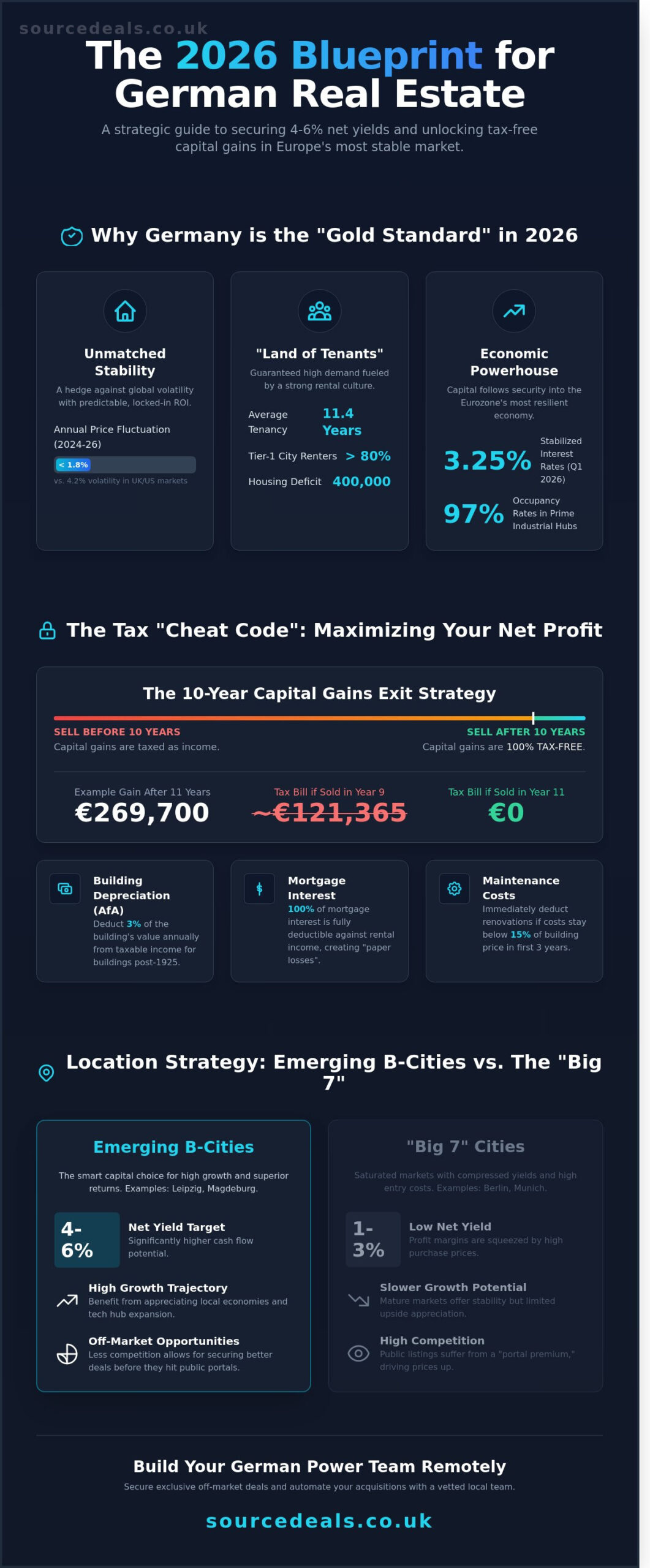
Germany enters 2026 as Europe’s premier destination for capital preservation. While the UK and US markets grapple with 4.2% inflation volatility, Germany’s disciplined fiscal policy keeps the residential sector anchored. Investors prioritize germany real estate investment because it offers a hedge against global uncertainty. The market isn’t about speculative bubbles; it’s about locked-in, predictable ROI. You’re buying into the most stable economy in the Eurozone, where property remains the ultimate defensive asset.
The data confirms the opportunity. Over 50% of the German population rents their home. In Tier-1 cities like Berlin and Hamburg, this figure climbs above 80%. This “Land of Tenants” creates a massive buffer for your cash flow. You aren’t chasing buyers; you’re managing a queue of vetted applicants. The Euro remains a pillar of strength for international portfolios. It provides a currency shield that US Dollar or British Pound assets often lack in the 2026 economic climate.
- Low Volatility: German property prices fluctuated less than 1.8% annually between 2024 and 2026.
- Industrial Power: Hubs in Munich and Stuttgart ensure 97% occupancy rates in prime corridors.
- Diversification: Euro-denominated assets protect against localized shocks in non-EU markets.
The 2026 Economic Forecast for Property Owners
Interest rates have stabilized at approximately 3.25% as of Q1 2026. This predictability has unlocked mortgage availability for international buyers seeking 10-year fixed terms. Tech hubs in Leipzig and the Berlin-Brandenburg corridor are currently outpacing traditional manufacturing for rental growth. Germany’s safe haven status is reinforced by a 14% increase in foreign direct investment since 2024. Capital follows security. Germany provides it.
Rental Culture: Why High Demand is Guaranteed
German tenants don’t just rent; they stay. The average tenancy lasts 11.4 years in major metropolitan areas. This reduces turnover costs and protects your net yield. Urbanization continues to squeeze supply, with a 400,000-unit housing deficit reported by the Federal Ministry in late 2025. High demand isn’t a temporary trend; it’s a structural reality of germany real estate investment. You’re entering a market where the supply-demand imbalance works in your favor every single month.
The Tax “Cheat Code”: Leveraging German Investment Laws
Germany’s tax framework provides a massive competitive advantage for those who treat it as a financial instrument. Smart investors don’t just look at rental yields; they look at the net profit after the Finanzamt takes its cut. By mastering the 10-year rule and depreciation schedules, you can effectively turn a standard germany real estate investment into a tax-shielded wealth engine. Stop focusing on gross numbers and start optimizing for the bottom line.
The Power of the 10-Year Exit Strategy
The Spekulationssteuer, or speculation tax, is the biggest hurdle for short-term flippers but a goldmine for patient investors. If you hold a non-owner-occupied property for at least 10 years, the capital gains from the sale are 100% tax-free. The math is simple. Imagine a €500,000 apartment that appreciates by 4% annually. After 11 years, your gain is roughly €269,700. Selling in year 11 nets you the full amount. Selling in year 9 could trigger a tax bill of up to €121,365, based on a 45% top income tax bracket. Secure your next high-yield asset by browsing our vetted property leads to start your 10-year clock today. To protect this exit, keep every Notar contract and your Grundbuch entry date on file; the Finanzamt tracks the exact day the title transfer was notarized, not when you moved in.
Depreciation and Maintenance Deductions
Germany allows you to write off the “wear and tear” of the building via AfA (Absetzung für Abnutzung). For most buildings completed after 1925, you can deduct 3% of the building’s value annually from your taxable rental income. This doesn’t include the land value, which typically accounts for 20% to 30% of the purchase price. Combined with mortgage interest deductibility, many investors report a “paper loss” while pocketing positive monthly cash flow. Maintenance costs offer another lever; if renovation expenses stay below 15% of the building purchase price during the first three years, you can deduct them immediately as operating expenses. Energy-efficient upgrades offer double tax benefits in 2026 because they qualify for both the standard maintenance deduction and specific federal subsidies under the updated 2024 Building Energy Act. This ensures your germany real estate investment remains compliant and profitable as the market shifts toward green standards.
- Interest Deductibility: Every Euro spent on mortgage interest is fully deductible against your rental income.
- 2026 Tax Update: The “Growth Opportunities Act” has extended degressive depreciation at 5% for new residential builds, allowing for massive front-loaded tax savings.
- Vetted Costs: Always separate land and building values in your purchase contract to maximize your AfA base.
Location Strategy: The Big 7 vs. Emerging B-Cities
Success in germany real estate investment depends on one choice: do you want a safe haven or a yield machine? The Big 7 cities, including Berlin, Hamburg, Munich, Cologne, Frankfurt, Stuttgart, and Düsseldorf, represent the defensive play. These markets offer yields compressed below 3 percent, but they provide unmatched liquidity and capital appreciation for long term holders.
Analyzing the Big 7 in 2026
Berlin remains the most complex battlefield. While the 2021 rent cap was overturned, local district protection laws still restrict luxury modernizations in sixty different areas. Investors must target new builds completed after 2014 to secure market rate returns. Munich and Hamburg function as wealth preservation vaults. With entry prices often exceeding ten thousand euros per square meter, these cities are for portfolios seeking twenty year stability rather than immediate monthly cash flow. You choose a Tier 1 city when your priority is protecting capital against inflation in a volatile global market.
The Rise of the B-City Yields
Strategic investors are shifting capital to B-Cities where 5.5 percent net yields are still achievable. Leipzig and Dresden have shed their up and coming labels to become established growth hubs. Leipzig’s population grew by twelve thousand residents in 2024 alone, driven by Porsche and DHL expansions. The Ruhr Valley, specifically Essen and Dortmund, offers the best value for multi family units. You can find off market deals here at fifteen to eighteen times annual rent, compared to thirty five times in Munich.
Identifying the next hotspot requires tracking infrastructure triggers and employment shifts. Use this checklist for vetting a B-city:
- Intel in Magdeburg: The thirty billion euro semiconductor plant is transforming the local rental market for professional lets.
- Tesla in Brandenburg: The commuter belt play is profitable; towns within forty five minutes of the Giga Berlin factory saw twenty percent price jumps between 2023 and 2025.
- University Clusters: Cities like Münster or Aachen ensure a constant ninety eight percent occupancy rate due to student demand.
- Job Diversity: Ensure the city has at least three distinct industries to avoid single employer risk.
Investing in the outskirts of major metropolitan areas allows you to capture the spillover demand from the Big 7. As rail networks expand, towns thirty kilometers outside Frankfurt or Munich offer a tactical entry point. When you master the B-city play, your germany real estate investment portfolio gains the resilience of the Big 7 with the aggressive cash flow of a high growth market.
The Remote Sourcing Process: How to Secure Vetted Deals
Execution is the difference between a high-yield germany real estate investment and a costly mistake. You need a streamlined system to identify, verify, and close deals without boarding a plane. Follow this five-step framework to build your 2026 portfolio with precision.
- Step 1: Define your Buy Box. Set strict parameters. Target a 5.8% gross yield in growth hubs like Leipzig or a 4.1% yield in stable A-cities like Munich.
- Step 2: Access Off-Market Flow. Bypass public portals where prices are often inflated by 12% or more. High-performing assets live in private networks.
- Step 3: Conduct Dual-Layer Due Diligence. Review digital records like the Energieausweis (Energy Certificate) and hire a local Bausachverständiger (surveyor) for a physical structural audit.
- Step 4: Execute the Notar Process. Use a Power of Attorney to sign from your home country, ensuring legal compliance without the travel costs.
- Step 5: Deploy Local Management. Secure a property manager (SEV) before you close to ensure day-one cash flow and tenant stability.
Finding Off-Market Opportunities
Retail portals like Immowelt are where deals go to die. By the time a listing hits the public market, it’s typically overpriced or picked over by local buyers. Sourcedeals solves this by connecting you with professional sourcers who uncover distressed assets and pocket listings. Every opportunity on our platform is vetted for compliance. We filter out the noise so you only see deals that meet institutional standards. This approach eliminates the 10% to 15% “portal premium” often found on public listings.
Closing the Deal Remotely
You don’t need to be in Frankfurt or Berlin to own property there. The German Notary (Notar) process is highly regulated and provides total security for your germany real estate investment. Non-residents typically use a Vollmacht (Power of Attorney) certified at a German consulate or via an apostille in the UK or UAE. This allows your legal representative to sign the deed on your behalf. Your ownership is protected by the Grundbuch (Land Registry), which is the definitive record of title. Budget for closing costs between 7.2% and 12.1% of the purchase price. This includes the property transfer tax (3.5% to 6.5% depending on the federal state), notary fees (1.5%), and registration costs (0.5%).
Building Your German Power Team with Sourcedeals
Success in 2026 requires more than just capital; it requires a vetted network. Germany’s legal and fiscal landscape is rigid. A single filing error can stall a transaction for 180 days or trigger unnecessary tax liabilities. Your germany real estate investment strategy only works when you have boots on the ground. Sourcedeals eliminates the guesswork by providing a direct link to a pre-vetted infrastructure designed for speed and compliance. We don’t just find deals; we provide the professional ecosystem needed to close them.
The Components of a Successful Power Team
- The Sourcing Agent: You need an expert in specific micro-locations like Berlin or Essen. These agents find off-market opportunities that never hit public portals, often securing assets at 15% below current market value.
- The Tax Advisor (Steuerberater): Essential for cross-border investors. They help you navigate double taxation treaties and structure your purchase to benefit from the 15.8% effective corporate tax rate available to certain property holding companies.
- The Property Manager (Hausverwaltung): They handle the “Hausverwaltung” duties, managing tenant relations and maintenance. Effective management is the difference between a 3% yield and a 5% yield in the German rental market.
Scaling Your Global Portfolio
Smart investors use German assets as a defensive anchor for their wealth. While high-growth markets like Egypt’s emerging luxury hubs where foreigners can buy property or Dubai property investment opportunities can offer yields exceeding 10%, they often come with higher volatility. Germany provides the Euro-backed stability that protects your principal. Integrating these diverse assets requires a sophisticated approach. Our real estate coaching programs teach you how to master multi-jurisdiction investing, allowing you to balance risk across different continents and currencies.
Don’t let bureaucracy stop your expansion. Move from the sidelines to your first acquisition with a team that understands the 2026 market dynamics. Efficiency is our priority. We’ve already filtered out the low-quality leads so you can focus on high-yield outcomes. It’s time to secure your position in Europe’s most stable economy. Explore our exclusive German property sourcing services and start building your international legacy today.
Your next move defines your portfolio’s resilience. Stop searching and start securing. The German market waits for no one, and the best off-market deals are claimed within 48 hours of listing on our platform. Get the insider advantage now.
Maximize Your Returns in Europe’s 2026 Powerhouse Market
Germany remains the undisputed anchor of European stability. By 2026, the strategic pivot toward B-Cities is projected to deliver rental yields 1.5% higher than saturated A-list hubs like Munich or Frankfurt. You’ve seen how the German tax code functions as a wealth-building tool, offering zero capital gains tax for assets held over 10 years. This isn’t just about safety; it’s about aggressive, tax-efficient growth. Success in germany real estate investment requires moving faster than the retail market. You can’t rely on public portals where margins vanish in seconds. You need elite access to the right data and the right people to win.
Sourcedeals removes the friction from international scaling. We provide 100% vetted off-market opportunities and direct expert coaching to ensure your strategy is bulletproof. Our comprehensive global portfolio management tools allow you to monitor your ROI and compliance with total precision from any timezone. Don’t settle for average returns when institutional-grade deals are within reach. Secure Your Next High-Yield German Deal with Sourcedeals and start building your legacy today. The market won’t wait for the cautious.
Germany Real Estate Investment FAQs
Can foreigners buy real estate in Germany without a residence permit?
Yes, you can buy property in Germany without a residence permit or German citizenship. The legal system allows 100% foreign ownership for both residential and commercial assets. You’ll need a valid passport and a notarized purchase contract to finalize the deal. While ownership is unrestricted, remember that buying property doesn’t automatically grant residency rights. Focus on securing a vetted local notary to handle the transaction efficiently.
What is the average rental yield for German property in 2026?
Investors should expect average gross rental yields between 3.5% and 5.5% in 2026. While “A-cities” like Munich offer lower yields around 2.9%, B-tier locations like Leipzig or Essen frequently hit the 5.1% mark. These figures represent a 0.4% increase from 2024 levels due to rising demand in the rental sector. Focus your germany real estate investment strategy on these high-growth secondary markets to maximize your annual ROI.
How much deposit do I need for a German investment property mortgage?
Non-resident investors typically need a 40% deposit to secure a mortgage from German lenders in 2026. Banks have tightened lending criteria, often requiring you to cover 100% of the closing costs upfront with your own capital. This means you’ll need roughly 52% of the total purchase price in liquid cash before starting. Ensure your portfolio meets these strict equity requirements to avoid delays in the financing phase.
Is there a property tax in Germany for non-residents?
Yes, non-residents pay two primary types of property tax in Germany. First, you’ll pay a one-time Real Estate Transfer Tax ranging from 3.5% to 6.5% depending on the specific federal state. Second, you’ll face an annual land tax based on the property’s assessed value. These rates are consistent for all owners regardless of residency status, so calculate these fixed costs into your initial financial modeling to protect your margins.
What are the main risks of investing in the German housing market?
The primary risks include strict rent control laws and high transaction costs that eat into short-term liquidity. The “Mietpreisbremse” cap limits rent increases to 10% above local benchmarks in designated tight markets. Additionally, if property values drop by even 5%, your high entry costs mean you’ll stay in the red for longer. Mitigate these risks by targeting off-market deals with existing high-yield tenancies already in place.
How does the 10-year tax rule work for international investors?
Germany waives all capital gains tax on investment properties held for more than 10 years. If you sell before this decade milestone, your profits are taxed at your personal income tax rate, which can reach 45%. This 10-year rule makes germany real estate investment a premier choice for long-term wealth preservation. It’s a powerful incentive that rewards patient, professional investors who prioritize stable appreciation over quick flips.
What are the total closing costs when buying property in Germany?
Total closing costs in Germany range from 10% to 15% of the purchase price. This includes the Real Estate Transfer Tax at an average of 5.5%, notary fees at 1.5%, and land registry fees at 0.5%. Real estate agent fees typically add another 3.57% including VAT. Budgeting for these 2026 price points is essential to ensure your net ROI remains competitive after all acquisition expenses are paid.
How can I manage a German rental property while living in the UK?
Hire a professional property manager to handle daily operations from the UK. These managers typically charge between 25 and 50 Euros per month to manage a single apartment unit. They handle rent collection, maintenance, and tenant communication, ensuring your investment remains hands-off. Secure a vetted manager with English-speaking staff to bridge the communication gap and maintain compliance with local German housing regulations.