
A staggering 82% of property investors lose high-yield opportunities to analysis paralysis because they treat a 2026 market like it’s 2010. If you don’t know exactly how to analyze a real estate deal in under 15 minutes, you’ve already lost the lead to a faster, more systematic competitor. Speed is the only currency that matters when securing off-market assets in a crowded market.
You likely agree that the real money is made in the off-market space, but the fear of hidden structural costs or miscalculated management fees keeps you stuck in spreadsheet limbo. It’s frustrating to watch vetted BMV opportunities slip away while you’re still trying to figure out if the ROI holds up against international benchmarks like Dubai’s tax-free yields. You need a system that removes the guesswork and replaces it with cold, hard data.
This guide changes everything by giving you the same high-speed framework pro-sourcers use to lock in 10% plus yields. We’ll break down a 15-minute quick-filter method to separate the gold from the noise, compare UK and Dubai metrics, and show you how to factor in sourcing fees to ensure your real-world ROI remains ironclad.
Key Takeaways
- Eliminate emotional bias and protect your capital by using market data as your primary defense during the sourcing process.
- Master the “Big Four” financial metrics to understand exactly how to analyze a real estate deal with professional-grade precision.
- Deploy the 15-minute “Quick Look” framework to rapidly filter through 100 leads and focus only on high-yield, off-market opportunities.
- Identify the unique complexities and massive potential within the 2026 “Golden Triangle” of the UK, Egypt, and Dubai.
- Transition from a solo investor to a portfolio mogul by leveraging vetted data and building a high-performance power team.
What Does it Mean to Truly Analyze a Real Estate Deal?
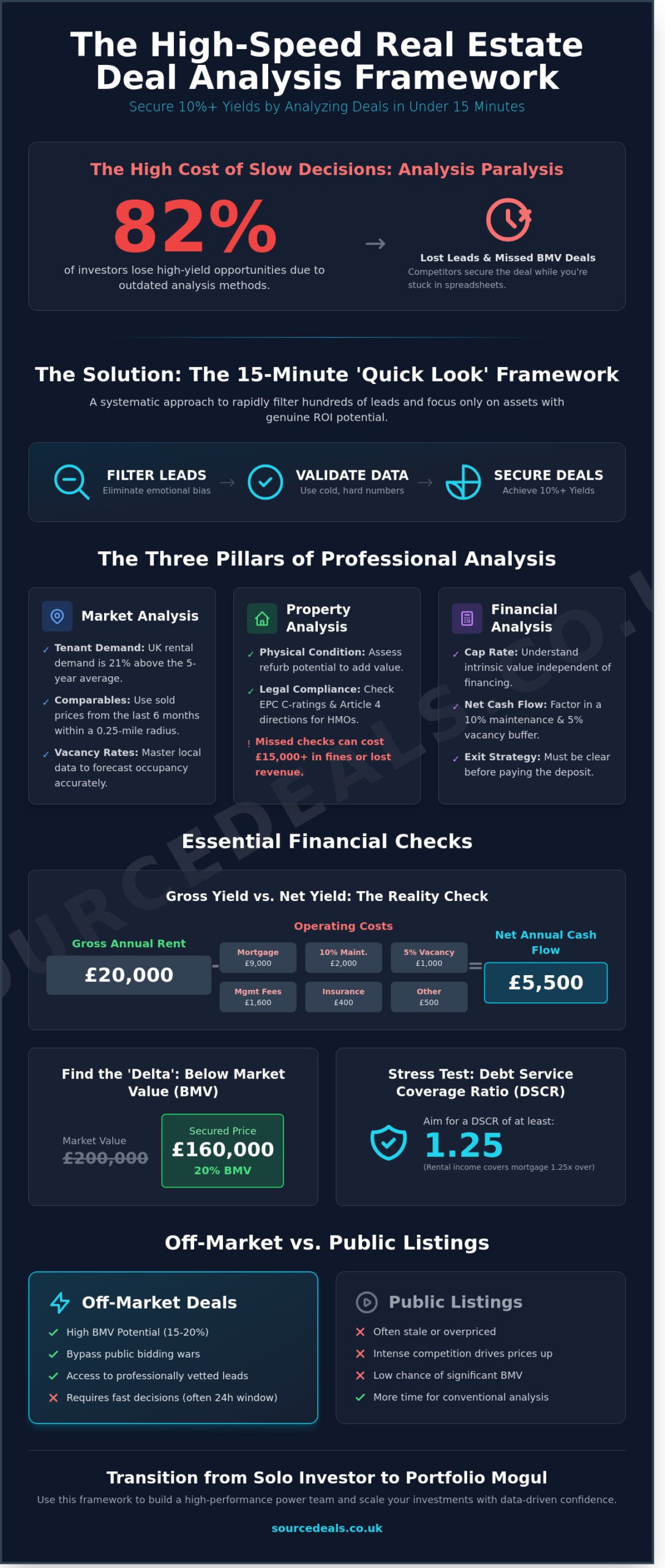
Real estate deal analysis is your primary defense against capital loss. It is the cold, calculated process of using financial metrics and granular market data to forecast a property’s future performance. You aren’t just looking at a building; you’re looking at a yield-generating asset. Learning how to analyze a real estate deal effectively prevents emotional buying and ensures you don’t overpay for a “feeling.” In the 2026 market climate, where UK base rates are projected to fluctuate between 4.5% and 5.5%, your margin for error has vanished. You must find the “Delta.” This is the specific gap between the asking price and the true Below Market Value (BMV), which often reaches 15% to 20% in secured off-market transactions.
The Three Pillars of Professional Analysis
- Market Analysis: You must master local tenant demand. In 2025, UK rental demand sat 21% above the five-year average. Look at vacancy rates and “comparables” within a strict 0.25-mile radius. Don’t guess. Use sold prices from the last 6 months to anchor your expectations.
- Property Analysis: Assess the physical shell and the “refurb” potential to add value. Check legal compliance immediately. This includes EPC C-rating requirements and local Article 4 directions for HMOs. A missed compliance check can cost you £15,000 in fines or lost revenue.
- Financial Analysis: Run the hard numbers. This involves calculating your Capitalization Rate to understand the property’s intrinsic value independent of financing. You need to forecast net cash flow after a 10% maintenance buffer and a 5% vacancy allowance. Your exit strategy must be clear before the deposit is paid.
Why ‘Off-Market’ Analysis Differs from Public Listings
Off-market deals move at a different velocity than public listings. On traditional portals, deals are often stale or overpriced by the time they hit your screen. Off-market opportunities via Sourcedeals.co.uk require faster decision-making, often within a 24-hour window. However, they offer significantly higher BMV potential because you’re bypassing the public bidding wars that drive prices up. You must rely on verified data from professional property sourcers who have already vetted the seller’s motivation.
Since there’s no public portal history to lean on, you verify “insider” info by cross-referencing local planning portals and recent land registry filings. Professional analysis transforms a risky lead into a vetted, high-yield investment. It’s about precision. If the numbers don’t work, you walk away. This disciplined approach ensures you only commit to deals that offer genuine ROI and long-term security. Understanding how to analyze a real estate deal in this specific, high-speed context is what separates the professional investor from the amateur.
The Essential Metrics for Every Property Investment
Numbers don’t lie. They provide the universal language needed to compare a £140,000 terraced house in Oldham with a £500,000 luxury villa in Hurghada. You can’t rely on gut feelings when capital is at risk. Successful investors ignore the noise and focus on the “Big Four” metrics. This streamlined approach is the fastest way to master how to analyze a real estate deal without losing hours to complex spreadsheets.
Investors in 2026 have shifted their focus significantly. The era of relying on 3% or 4% annual capital appreciation to “save” a bad deal is over. High interest rates, which hovered around 5.25% in 2024, have forced a return to fundamentals. You must prioritize immediate cash flow. A property that doesn’t put money in your pocket from month one is a liability, not an investment. This comprehensive guide to real estate analysis emphasizes that setting strict financial thresholds is the only way to protect your downside in a volatile market.
Stress testing your numbers is non-negotiable. Don’t just calculate your profit based on today’s mortgage rates. Run your figures against a 7% or 8% interest rate hike. If the deal turns into a “negative carry” scenario where you’re paying out of pocket to keep the property, walk away. Professional investors look for a Debt Service Coverage Ratio (DSCR) of at least 1.25, meaning the rental income covers the mortgage 1.25 times over. This buffer ensures you survive market fluctuations and unexpected maintenance spikes.
Gross Yield vs. Net Yield: The Reality Check
Marketing brochures love Gross Yield. It’s a simple calculation: Annual Rent divided by the Purchase Price. While a 10% Gross Yield looks impressive on a listing, it’s often a vanity metric that hides the truth. It ignores the friction of owning property. Calculating the Net Yield provides the truth because it’s the only metric that accounts for real-world operating costs. To find it, subtract every expense, including 10% for management, 5% for voids, and 10% for ongoing maintenance, from your annual rent. Divide that final figure by the total acquisition cost to see if the deal actually stacks up. Aim for a Net Yield of at least 6% to ensure the project is worth your time.
Cash-on-Cash Return (CoC) and ROI
Cash-on-Cash (CoC) return is the pulse of your portfolio. It measures the actual cash profit against the physical money you “left in” the deal after financing. If you invest £60,000 for a deposit and fees and receive £6,000 in annual profit, your CoC is 10%. This is the most critical metric for investors looking to scale quickly. It tells you exactly how fast you can recycle your initial capital into the next project.
Return on Investment (ROI) is a broader, long-term calculation. It accounts for equity growth through mortgage paydown and potential tax benefits alongside your cash flow. While ROI shows your total wealth accumulation over a five or ten-year period, it won’t help you pay the bills today. Focus on CoC to keep your business liquid and agile. When you know how to analyze a real estate deal using CoC, you can spot high-velocity opportunities that others miss. Using a platform to find vetted off-market opportunities can significantly boost these percentages by cutting out the middleman and securing BMV (Below Market Value) prices.
The 15-Minute ‘Quick Look’ Analysis Framework
Sourcing isn’t a hobby; it’s a high-volume numbers game. Professional investors know that finding one “unicorn” deal requires filtering at least 100 leads. If you spend three hours on every lead, you’ll never scale. Efficiency is your competitive advantage. This 15-minute framework stops “Analysis Paralysis” before it drains your energy. It provides a ruthless filter to protect your most valuable asset: your time. Learning how to analyze a real estate deal effectively starts with a commitment to speed. You don’t need a site visit or a full survey yet. You need a reason to say “No.”
The objective of the “Quick Look” isn’t to prove a deal works. It’s to find the one fatal flaw that makes it a waste of capital. If a property passes these two steps, it earns a spot on your shortlist for deeper due diligence. If it fails, you discard it and move to the next lead in the funnel immediately.
Step 1: The ‘Back of the Envelope’ Yield Test
You must calculate the gross yield in under 60 seconds. Take the expected annual rent and divide it by the asking price. Multiply by 100. If the result is below your 7% floor, kill the deal. Don’t try to “make the numbers work” by hoping for massive capital appreciation. Stick to the data. This rapid assessment is the first hurdle in how to analyze a real estate deal without getting emotionally attached to the aesthetics of a building.
- Price Per Square Foot: Compare the asking price against the local average. If the area average is £250 per square foot and the lead is priced at £310, the “below market value” (BMV) claim is likely false.
- Sold vs. Asking: Check Land Registry data for sales within the last 6 months in the same postcode. If properties are selling for 15% less than their asking prices, use that lower figure for your calculations.
- The 1% Rule: In high-yield markets, the monthly rent should ideally approach 1% of the purchase price. If it’s closer to 0.5%, the cash flow will likely be thin after expenses.
Step 2: Identifying Red Flags and Deal Breakers
Once the yield passes the initial test, scan for “deal killers” that could trap your capital. A high yield is irrelevant if the property is un-mortgageable or carries hidden liabilities. Professional sourcers look for compliance and structural red flags that would stop a traditional lender in their tracks. This step separates the amateurs from the seasoned pros who value security as much as ROI.
Look specifically for these three high-risk factors:
- Lending Obstacles: Check for properties with no working kitchen or bathroom, or those with short leases under 80 years. These usually require bridging loans or cash, which changes your ROI profile instantly.
- Service Charge Creep: In apartment blocks, especially in Manchester or Dubai Marina, service charges can exceed £3,500 annually. If these charges eat more than 25% of your gross rental income, the deal is dead.
- EPC Legislation: Verify the Energy Performance Certificate. With UK government targets aiming for an EPC rating of C for new tenancies by 2028, a property currently at an E rating represents a hidden cost of £5,000 to £15,000 in future upgrades.
By the end of these 15 minutes, you’ll have a binary outcome. You either have a deal that pencils out mathematically and legally, or you have a lead for the bin. Move fast, stay objective, and keep your funnel moving.
Analyzing International and Off-Market Opportunities
Analyzing a cross-border deal requires a shift from local intuition to cold, hard data. You aren’t just buying brick and mortar; you’re buying into a foreign tax jurisdiction and a currency pair. For 2026, the Golden Triangle of the UK, Egypt, and Dubai offers the most aggressive growth profiles for serious portfolios. UK markets like Manchester provide 6.5% average yields, while Dubai’s luxury sector saw 15.9% price growth in 2024. Egypt’s New Capital offers entry points 40% lower than established regional hubs. You must calculate the Cost of Convenience immediately. This includes sourcing fees and management commissions that eat into your gross yield. Learning how to analyze a real estate deal in a market you’ve never stepped foot in relies on verified local intelligence and digital due diligence.
Successful remote investors don’t guess. They use 3D walkthroughs, independent valuation reports, and localized heat maps to confirm demand. If you can’t see the property, you must see the data. This means reviewing 12 months of historical occupancy rates for the specific postcode, not just the general city. Off-market deals are the gold standard here because they bypass the emotional bidding wars of traditional portals. These deals often come with a 10% to 15% built-in equity cushion, providing a safety net against currency fluctuations in emerging markets like Egypt.
Due Diligence in Emerging Markets (Egypt & Dubai)
In Dubai and Egypt, the payment plan is your primary leverage tool. Off-plan properties often feature 80/20 or 60/40 structures. This allows you to control a multi-million dollar asset with a 10% or 20% down payment. However, your ROI model must account for high-intensity management. Vacation rental fees in Dubai typically range from 15% to 25% of gross revenue. You also need to verify remote rent collection capabilities. Ensure the developer or agency uses a secure, blockchain-verified or bank-integrated portal to remit your funds across borders without 5% leakage in hidden bank fees.
The Sourcing Success Fee: An Investment, Not a Cost
Professional sourcing is the only way to access genuine off-market inventory. When you understand how to analyze a real estate deal, you realize a 2% to 3% sourcing fee is a rounding error compared to the value secured. If a sourcer finds a property at 15% BMV (Below Market Value), that 3% fee is fully tax-deductible and paid for by the immediate equity gain. Stop viewing the fee as an expense; view it as a filter that removes low-quality leads. You can see how our expert UK property sourcing services find vetted deals that never hit the open market, saving you hundreds of hours in manual research.
- BMV Calculation: Always compare the purchase price against three recent (last 90 days) sold prices of identical units in the same building or street.
- Fee Integration: Add the 3% sourcing fee to your “Cash-in” figure to get a true reflection of your initial ROI.
- Compliance Check: Only work with sourcers who are registered with the Property Ombudsman and have valid Professional Indemnity Insurance.
The speed of the market in 2026 doesn’t allow for hesitation. Deals in the Golden Triangle move within 48 hours of being released to private lists. By the time a property hits a public website, the 10% BMV margin has usually evaporated. Your goal is to have your capital ready and your analysis framework set so you can pull the trigger on a vetted, high-yield opportunity the moment it lands in your inbox.
From Analysis to Acquisition: Building Your Power Team
Analysis is a vital tool, but it isn’t the final destination. Your results are only as good as the data you input. Top-tier UK investors avoid speculative portal data. They rely on vetted, off-market sources where the numbers are verified before the lead even hits their inbox. If you’re working with 98% accurate data, your exit strategy becomes a mathematical certainty rather than a hopeful guess.
Scaling from a solo investor to a portfolio mogul requires massive leverage. You can’t manage 20 units alone while hunting for your next BMV opportunity. You need a system that works while you sleep. By 2026, the turnkey investment strategy will dominate the UK market. Investors are already shifting toward assets that are fully refurbished and tenant-ready. This shift minimizes the 4 to 6 month void periods typically seen in heavy renovation projects, allowing for immediate ROI.
Execution is the bridge between a spreadsheet and a bank balance. Mastering how to analyze a real estate deal gives you the confidence to pull the trigger, but your power team ensures the deal actually closes. Don’t let analysis paralysis keep you on the sidelines while 82% of high-yield off-market opportunities are snapped up within 48 hours of listing.
Leveraging Professional Coaching for Better Deals
A coach helps you spot hidden value that a basic calculator might miss. Mentorship allows you to move from standard residential buy-to-lets into complex HMO or commercial-to-residential strategies. These high-level plays often yield 12% to 15% more than traditional lets. You can accelerate your portfolio growth with professional real estate investment coaching to gain the insider knowledge required for these advanced acquisitions. Expert eyes identify risks in the small print, saving you thousands in potential legal or structural pitfalls.
The Final Checklist Before You Sign
Speed is your greatest asset in a competitive market. Before you sign any contract, you must ensure your finance is robust and your team is standing by. A delay of 24 hours can cost you a deal with a 25% BMV discount. Use this final checklist to ensure you’re ready to move from the analysis phase to the acquisition phase with total confidence.
- Confirm Finance: Ensure your Buy-to-Let mortgage broker has a current Decision in Principle (DIP) at your target LTV.
- Verify Compliance: Check that your property sourcer is fully registered with the Property Redress Scheme and has active Professional Indemnity Insurance.
- Finalize Management: Have a management agreement ready so your property starts generating yield the moment the keys are handed over.
- Audit the Numbers: Run your how to analyze a real estate deal process one last time with updated interest rate data to confirm the margin.
The most successful investors don’t wait for the perfect market; they use perfect data to make the market work for them. Stop watching from the sidelines. The data is ready, the yields are verified, and the opportunities are waiting. Register for exclusive off-market deals on Sourcedeals.co.uk and start building your high-yield portfolio today.
Master the 2026 Market Dynamics Today
Success in the next decade hinges on speed and precision. You’ve now mastered the 15-minute quick look framework and identified the essential metrics required for the 2026 investment landscape. Knowing how to analyze a real estate deal is no longer just about calculating yield; it’s about identifying vetted, high-yield assets before the competition even knows they exist. By focusing on off-market opportunities across the UK, Dubai, and Egypt, you position your portfolio for maximum growth while others fight for scraps on public portals.
Serious investors prioritize compliance-focused sourcing and transparent reporting to mitigate risk. You don’t have time for unverified leads or messy data. Our platform bridges the gap between analysis and acquisition, providing you with 100% vetted opportunities that align with your 2026 strategy. It’s time to stop searching and start securing assets that deliver tangible results.
Secure your next high-yield deal with Sourcedeals.co.uk
The market waits for no one. Take your next step with total confidence.
Frequently Asked Questions
What is the most important metric when analyzing a real estate deal?
ROI is the definitive metric because it measures the performance of your actual cash outlay. If you’re looking for a professional standard, aim for a minimum of 15% ROI on a standard buy-to-let. This figure ensures your capital works harder than it would in a 5% high-interest savings account. Secure BMV deals to boost this number instantly. Always calculate this by dividing your annual net profit by the total cash left in the deal.
How do I calculate the ROI on a vacation rental property?
Calculate vacation rental ROI by dividing your annual net profit by your total initial investment, including furniture and legal fees. You must use a conservative 65% occupancy rate to stay realistic. Short-term lets often command 3x the rent of long-term tenancies. Deduct 20% for management and cleaning to ensure your final percentage reflects the actual cash hitting your bank account after all operational costs are paid.
Is it better to focus on high yield or high capital growth?
Choose high yield if you need immediate cash flow to replace a salary; choose capital growth if you’re building a 20-year legacy. A 7% net yield is the baseline for sustainable scaling in the UK market. While London properties showed 450% growth over the last 30 years, high-yield hubs like Liverpool currently offer 8% yields that protect you against 4% interest rate spikes. Both paths require vetted, off-market data.
How do I account for property management fees in my analysis?
Account for property management by deducting 12% of your gross monthly rental income from your cash flow projections. Don’t forget to add 20% VAT to this fee, bringing the total hit to 14.4%. This is a non-negotiable expense for hands-off investors. Factoring this in early ensures you don’t overstate your monthly profits by £150 or more on a standard £1,250 rental, keeping your financial model robust and accurate.
What is a ‘good’ Cap Rate for UK property in 2026?
A good Cap Rate for UK residential property in 2026 sits between 6% and 8% depending on the specific region. Regional cities like Sheffield and Birmingham are projected to hit 7.2% as demand outstrips supply. If a deal offers less than 5.5% in a high-inflation environment, the risk premium isn’t sufficient. Focus on off-market opportunities to secure these higher-performing figures that outperform the standard 4% found on traditional portals.
How can I analyze a property deal if I’m investing from overseas?
You can effectively learn how to analyze a real estate deal from overseas by leveraging vetted local data and virtual walkthroughs. Use platforms that provide verified, compliant deal packages to eliminate the 5,000-mile gap. Rely on RICS valuations and local 2024 comparable sales data rather than portal asking prices. This data-first approach removes the emotional bias that often leads to overpaying for sub-par assets in unfamiliar territories.
What are the common mistakes beginners make during deal analysis?
The most frequent mistake is using a 0% void period in financial models. Professional investors always factor in a 5% to 8% void allowance to cover tenant turnover. Beginners also tend to underestimate repair costs by 25% on average. Always add a 15% contingency buffer to any refurbishment quote to keep your 15-minute analysis grounded in reality. Ignoring these numbers is a fast track to negative cash flow.
Should I factor in refurbishment costs before or after calculating yield?
You must factor in refurbishment costs before calculating your all-in yield to understand the true return. A property bought for £150,000 with a £30,000 refurb is a £180,000 investment. Calculating yield only on the purchase price is a dangerous trap that inflates your perceived success by 20%. Use the total capital expenditure to ensure your how to analyze a real estate deal process stays accurate and profitable.